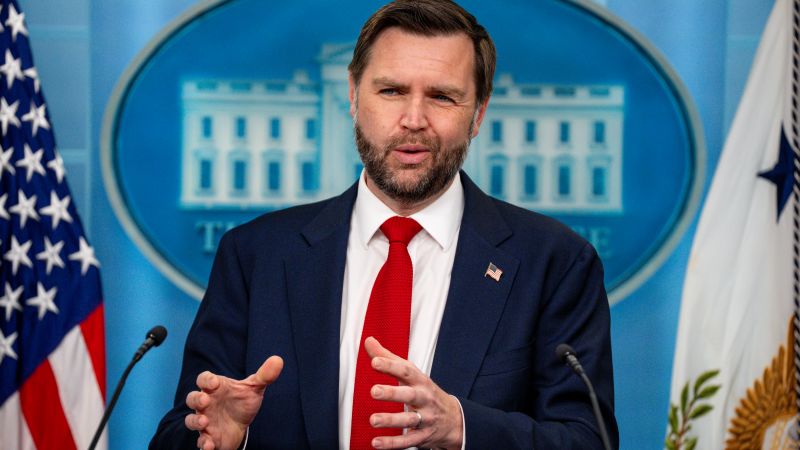
Vice President JD Vance has taken a prominent role in negotiating a peace agreement with Iran, facing significant criticism from Republican hawks and potential political repercussions for his 2028 ambitions.
Vice President JD Vance has stepped forward to lead the negotiations and promotion of a peace agreement aimed at ending ongoing hostilities with Iran. This initiative has sparked significant backlash from hawkish Republicans, who accuse the administration of capitulating to Iranian demands.
Vance's involvement comes at a critical juncture as the Trump administration has struggled to bring Iran to the negotiating table, with a formal signing in Switzerland recently postponed. The vice president's decision to take the forefront in these discussions is seen as a high-stakes gamble, particularly as he is considered a potential candidate for the presidency in 2028.
In recent developments, a planned in-person summit was abruptly canceled when Vance withdrew from his flight to Switzerland on Thursday evening. The decision drew ire from GOP hawks, who criticized the administration for not promptly sharing specific details of the agreement. Following the release of the accord's text, many Republicans labeled it excessively lenient towards Iran, with one senator calling it 'the worst foreign policy blunder in decades.'
Confusion has arisen as both President Donald Trump and Vance have issued differing statements regarding the agreement's future, particularly concerning the consequences if Iran fails to comply. Vance, known for his skepticism towards war, has been a vocal supporter of the peace deal, promoting it across various media platforms despite its perceived shortcomings in achieving U.S. strategic goals.
A former senior official from the Trump administration remarked, 'Somebody has told JD Vance that a bad deal is better than no deal,' highlighting concerns that Vance is shouldering the political risk of the agreement, which could backfire if it fails.
This situation poses a significant challenge for Vance, who has previously expressed reservations about foreign military engagements. The criticism he faces could jeopardize his aspirations for the presidency, particularly as he has shifted from being an outspoken opponent of foreign wars to actively defending the military campaign in Iran while simultaneously pursuing peace.
The administration's approach has raised eyebrows among allies and adversaries alike, including Secretary of State Marco Rubio, who is also viewed as a contender for the 2028 election. Some within the administration have expressed discomfort with Vance's contrarian stance, fearing it could complicate decision-making processes related to the ongoing conflict.
During a recent press conference, Trump acknowledged the precarious position Vance finds himself in, humorously stating, 'If it works out, I’m going to take the credit. If it doesn’t work out, I’m blaming JD.'
Vance has positioned the agreement as the best opportunity to conclude the war, asserting, 'People say the Iranians will never change their behavior. Well, maybe that’s true, and if so they don’t get any of the benefits of the bargain. But isn’t it worth trying?'
While Vance has downplayed the implications of his involvement for his political future, some analysts warn that if the deal collapses, he may be seen as the scapegoat. Curt Mills, an ally of Vance, noted, 'There is a risk if the deal blows up... But the default was a disaster. JD is not going to be president if the administration is this unpopular.'
Vance's engagement in peacemaking efforts predates the conflict, including a meeting with Oman’s foreign minister in February 2023 to avert war with Iran, prior to Trump's military actions that resulted in the elimination of Iranian leadership.
Despite initial setbacks, Vance has remained actively involved in negotiations, previously advocating for a role in face-to-face discussions with Iranian officials, which White House aides believed would enhance U.S. leverage. However, concerns arose that his leading role could backfire politically if negotiations failed, as evidenced by unflattering media coverage following a collapsed summit in Islamabad.
Vance's eagerness to promote the new agreement has been evident, as he has engaged in a media blitz to frame it as a significant achievement for the American public, claiming it grants the U.S. increased leverage over Iran. He stated, 'If the Iranians comply with this deal, it is going to fundamentally transform the Middle East.'
Yet, as criticism mounts, conservative commentators and Republican lawmakers have condemned the agreement for proposing a $300 billion fund for Iran and for lifting sanctions without securing concrete concessions on its nuclear program. Senator Bill Cassidy criticized the framework, stating it signaled a significant decline in U.S. foreign policy strength compared to previous administrations.
Amidst this growing skepticism, some White House sources have defended Vance, arguing that he is not being unfairly targeted and that the administration believes the agreement could lead to a favorable outcome. They noted that early voter enthusiasm for the peace initiative suggests potential political benefits for both Vance and Trump.
However, some of Vance's supporters have expressed concern over his rush to take ownership of an agreement that may falter. One Republican strategist advised, 'If I was his political adviser, I would tell him to sit back and let this play out.'
As Vance prepares for the next steps in the negotiations, the outlook for the agreement remains uncertain, with even his colleagues exhibiting doubt about its potential for lasting peace. In a recent interview, Vance suggested that if the deal fails, the U.S. could still move forward, saying, 'At least the Strait of Hormuz is open and we can get on with our lives as a country.'
In contrast, Trump conveyed a more dismissive attitude regarding the timeline for success, stating, 'If it doesn’t get done in 60 days, that’s all right. We go back to bombing.'