Vance Navigates Challenges of Iran Deal Amid Trump's Overshadowing Presence
Vice-President JD Vance defends the controversial US-Iran agreement, facing challenges as speculation about a 2028 presidential run grows and President Trump remains a dominant figure.
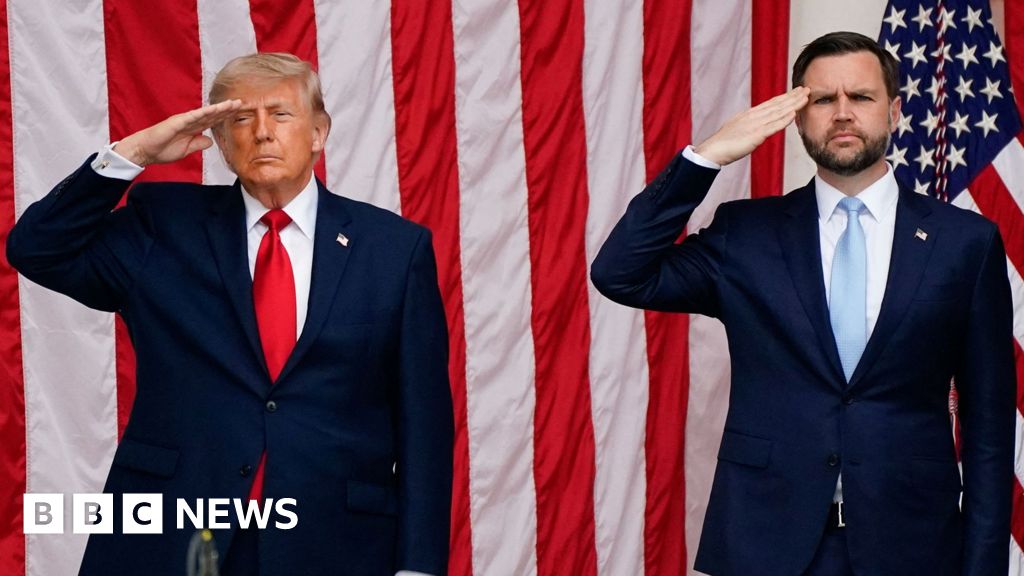
During a press briefing at the White House on Thursday, Vice-President JD Vance defended the US-Iran deal, addressing a question about whether President Donald Trump had set him up as the 'fall guy' for a plan that faces widespread disapproval among Republicans in Washington. Vance responded, stating, 'I think the president was joking,' in reference to Trump's earlier comment suggesting he might blame Vance if the deal were to fail.
Throughout the week, Vance has been a vocal supporter of the memorandum of understanding between the US and Iran. However, he often found himself overshadowed by Trump's presence, particularly as uncertainty loomed over the logistics of a planned signing ceremony in Switzerland with Iranian officials. This uncertainty highlighted the difficulties Vance faces in managing a pivotal issue of his vice-presidency.
On Thursday evening, the White House announced that Vance would not be traveling to Switzerland for the signing ceremony, at least for the time being. Despite these challenges, Vance has continued to advocate strongly for the deal, even going so far as to criticize Israel's reaction to the agreement, a stance that was more forthright than Trump's recent comments.
This situation is particularly delicate for Vance, who recently released a memoir that has sparked speculation regarding a potential presidential run in 2028. Selling this interim deal to a party divided between anti-interventionist MAGA supporters and conservative hawks who accuse the administration of yielding to Iran will be a significant hurdle for him.
Other senior officials within the administration are not facing the same level of scrutiny as Vance regarding the Iran deal. Secretary of State Marco Rubio, who is also considered a potential candidate for the Republican nomination in 2028, has managed to stay out of the spotlight concerning the war. Meanwhile, Secretary of Defense Pete Hegseth has been an outspoken advocate for the military campaign but has not taken on a leading role in the diplomatic discussions surrounding the agreement, unlike Vance.
Some Republicans perceive Vance's focus on the Iran conflict as a thankless task, given Trump's history of shifting blame onto his subordinates for unpopular decisions. Republican strategist Matt Mackowiak commented, 'It's not in the president's nature to cede the limelight and he's done that here. That does feel like a deliberate choice.'
A long-time Republican strategist and critic of Trump remarked that the president appears to be placing the responsibility for the deal squarely on Vance's shoulders. 'It's classic Trump to throw JD under the bus,' the source, who preferred to remain anonymous, noted.
While it is not certain that Vance's association with the Iran deal will have negative political repercussions, a successful final agreement that limits Iran's nuclear capabilities could position him as a key player in achieving a longstanding goal for the US and its allies in the region. However, the next 60 days will be critical, as there is no assurance that a comprehensive deal will be reached or that any long-term agreement will satisfy critics domestically and internationally.
'Vance being connected to the Iran war is one more way [that critics will] hold him accountable for Trumpism,' stated Terry Holt, a seasoned Republican consultant.
The mixed messages surrounding the Iran deal throughout the week further emphasized the challenges Vance faces. The administration had announced on Sunday that Iran agreed to the memorandum of understanding but did not disclose specific details, leading to confusion regarding the agreement's contents. Vance attempted to clarify these details in multiple interviews, mentioning to CBS News that Iran could gain access to a $300 billion reconstruction fund if it adhered to the deal's terms.
However, just hours later, Trump contradicted this claim on social media, labeling reports of the US funding Iran as 'Fake News' and asserting, 'we're not putting up 10 cents.' When the agreement's text was finally made public, it included a commitment for the US to collaborate with regional partners to create a mutually agreed plan for Iran's $300 billion reconstruction.
Regarding Iran's nuclear ambitions, Vance echoed Trump's sentiment that the interim deal represented a significant first step toward preventing Iran from developing nuclear weapons. However, the agreement did not delve deeply into nuclear issues, leaving those to be addressed in subsequent negotiations.
Throughout the week, Vance also promoted his new book discussing his faith and conversion to Catholicism. Despite this, he was unable to escape the ongoing news cycle. While he engaged in a debate with Whoopi Goldberg on ABC's The View, Trump was meeting with world leaders at the G7 summit in Évian-les-Bains, France.
At a press conference on Wednesday, Trump reiterated his previous joke about blaming Vance if the Iran deal fails, while also downplaying the significance of the memorandum, questioning whether it warranted his signature. Shortly thereafter, Trump publicly signed a copy of the agreement during a lavish dinner with French President Emmanuel Macron at the Palace of Versailles, raising questions about the necessity of Vance organizing a separate signing event in Geneva.
The situation was clarified later when the White House confirmed that Vance would not be traveling to Switzerland, citing that the logistics for talks with Iran had not yet been finalized.
As Trump remained abroad, Vance continued to advocate for the deal amidst criticism from former Senate colleagues. Republican Senator Bill Cassidy of Louisiana expressed concerns that the deal failed to curb Iran's nuclear ambitions and suggested that Iran would continue to leverage threats regarding the Strait of Hormuz. Senate Armed Services Committee Chairman Roger Wicker of Mississippi remarked that the agreement was 'completely out of step with the president's goals.'
During the press briefing on Thursday, Vance pointed to declining petrol prices as evidence that the deal was already yielding benefits for Americans. He expressed optimism that the agreement would continue to produce positive outcomes as long as Iran adhered to its commitments and a final peace deal was reached once key issues were negotiated. 'If they change their behavior, big things are going to happen,' he stated. 'If they don't, no skin off our backs. Either way, we win.'
With Vance at the forefront of these negotiations, as Trump indicated, the outcome will significantly impact his political future.