President Trump’s memorandum of understanding with Iran remains unpublished, leading to bipartisan criticism and confusion regarding its terms and implications.
President Donald Trump's memorandum of understanding (MOU) with Iran has yet to be made public days after its announcement, leading to bipartisan backlash and uncertainty about its contents. US officials have characterized the text as unclear and noted that it does not reflect critical backchannel commitments made by Iran.
Key allies, including Israel and Senate Republicans, have reported that they have not seen the MOU's text. Critics suggest that the eventual release of the terms may not alleviate concerns about a potentially unfavorable agreement.
The failure to disclose the memo's specifics, initially celebrated as a significant diplomatic achievement by Trump over the weekend, has created confusion and anxiety among Republican hawks, while Democrats have intensified their criticisms. Leaks from Middle Eastern media have indicated that the MOU might lack firm commitments, benchmarks, and clear sequencing, complicating the White House's position.
A point of contention has arisen over a reported $300 billion reconstruction fund for Iran, which would be financed by regional powers and guaranteed by the US government. Officials have clarified that no American funds would be involved and that any benefits would depend on Iran complying with US demands. This situation has led to accusations of hypocrisy, particularly given Trump's past statements about Iranian assets released following the Obama administration's 2015 nuclear deal.
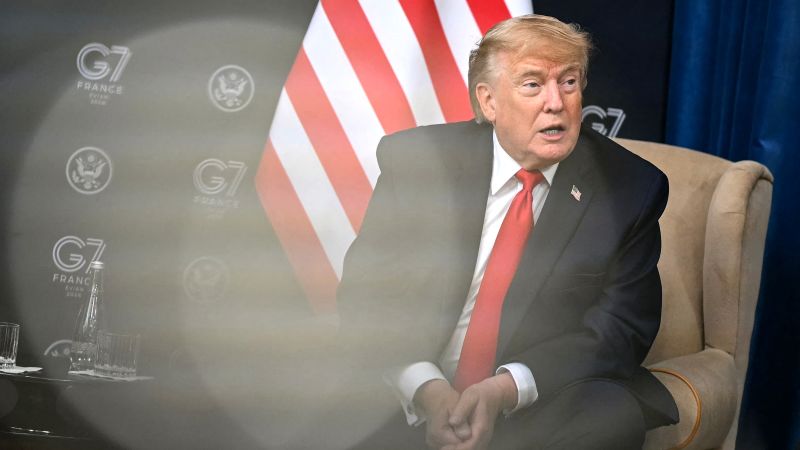
During a G7 summit in France, Trump defended the agreement and expressed a willingness to publicly read it. Vice President JD Vance, who has been tasked with promoting the MOU domestically, attributed the delay in publication to diplomatic complexities in the Muslim and Arab world. He emphasized that any economic benefits for Iran would hinge on the country adhering to a commitment to not pursue nuclear weapons.
Vance's remarks suggest that the administration, which prides itself on deal-making, envisions a potentially transformative agreement for Iran that could alter its status as a pariah state. He stated on Fox News, "We fundamentally have transformed the Middle East, whether they comply or not. This is just icing on the cake, assuming they do all the right things."
However, the lack of clarity two days after Trump declared a major victory on his 80th birthday raises concerns that the administration, which previously struggled with messaging regarding the initiation of the conflict, risks repeating the same mistakes during its conclusion.
Senior officials initially indicated that the MOU was digitally signed on Sunday and would be formally signed in Switzerland on Friday, at which point the full text would be released. As political tensions escalated, US officials expressed hope to disclose the text soon, describing its language as extremely vague and not reflecting critical commitments made by Iran.
Diplomacy, particularly with Iran, is notoriously challenging. Trump's assertion that upcoming discussions on Iran's nuclear program would be "easier" has been criticized as ill-advised, especially given that negotiations leading to the previous nuclear deal took approximately 18 months. US officials mentioned that some language in the MOU is intentionally vague to allow Iranian negotiators to present their work in a challenging domestic political landscape.
This approach is generally considered sensible, as successful diplomatic negotiations often require sensitivity to the constraints faced by the opposing side, particularly when dealing with a repressive regime. Effective peacemaking can involve creating an illusion of progress to generate momentum for difficult negotiations.
Despite skepticism, it may be premature to dismiss the possibility that the MOU could lead to tangible progress, especially since both Iran and the US have strong incentives to end the conflict. Canadian Prime Minister Mark Carney, a frequent critic of the Trump administration, remarked that he believed the MOU to be a "game changer," although he characterized it more as a ceasefire extension than a comprehensive agreement.
Trump faces mounting pressure to justify the significant economic and geopolitical disruption caused by the war, which has resulted in the deaths of 13 US service members and an undetermined number of Iranian civilians, along with billions of dollars spent on military operations. Critics argue that he has done little to resolve issues stemming from the conflict, such as Iran's blockade of the Strait of Hormuz, a crucial oil transit route, and have noted a lack of concrete, verifiable commitments from Iran regarding nuclear development.
The administration's primary defense is that it has severely impaired Iran's nuclear program through airstrikes last year and has eliminated its stocks of highly enriched uranium, making it impossible for Iran to develop a nuclear weapon. However, this argument does little to assuage political concerns regarding the reasoning behind the war's initiation.
A vague MOU may further bolster critics who contend that Trump prioritizes branding and short-term victories over the substantive details necessary for achieving meaningful change. Additionally, Trump is confronted with a skeptical political landscape, exacerbated by his claims on social media that "the deal with the Islamic Republic is complete," which may have raised expectations that a simplistic diplomatic text cannot fulfill.
Concerns are particularly acute among Senate Republicans, including Trump ally Senator Lindsey Graham, who may need to lift sanctions as part of any final agreement with Iran. Senate GOP leader John Thune expressed his desire for more information and details regarding the MOU.
It is striking that prominent Republicans remain uninformed about a significant agreement, and it is equally concerning that Israel, a key ally in the conflict, is also in the dark. This situation suggests a growing rift between these allies. Bipartisan Israeli politicians fear that Trump may have agreed to a cessation of hostilities that could jeopardize their national security, particularly if it includes the Iran-backed Hezbollah militia in Lebanon. An Israeli source informed CNN that Prime Minister Benjamin Netanyahu's government requested to review the agreement but was denied access.
Israeli officials are also concerned that the MOU may not adequately address Iran's missile programs and its proxy groups, such as Hamas in Gaza and the Houthis in Yemen. The White House has not provided clarity on these matters.
Democrats are leveraging the current uncertainty to intensify their critiques of a president who returned to office promising to end foreign conflicts. Senate Minority Leader Chuck Schumer stated that "the American people deserve details and full transparency," questioning what benefits have been achieved from Trump's military actions.
Wendy Sherman, a former deputy secretary of state involved in negotiating the Obama-era nuclear deal, commented that the administration's hesitance to release the MOU speaks volumes about its contents. She suggested that the administration is likely anxious about how the agreement will be perceived, indicating that Trump may be seeking a celebratory moment during the signing ceremony.
If the eventual release of the MOU aligns with the descriptions provided by US officials, the administration may face accusations of a naive approach towards a repressive regime that has emerged from the war in a potentially more extreme form. The idea of Washington making concessions before nuclear negotiations with such a longstanding adversary may appear imprudent, especially considering that nearly 50 years into an Islamic revolution, Iran remains defined by its opposition to Western values and its authoritarian governance.
One official stated that "people shouldn’t read too much into the language of the MOU," characterizing it as a "political document." However, given the highly charged political atmosphere surrounding Trump's second term, this may be an unrealistic expectation.
The key takeaway from the developing details surrounding Trump's agreement is that while active hostilities may have ceased—at least for the time being—the ongoing crisis with Iran is far from resolved.