Trump's Reduction of National Security Council Staff Raises Concerns Ahead of Iran Conflict
President Trump significantly cut the National Security Council staff ahead of military actions against Iran, raising concerns about national security coordination and strategy planning.
In the past year, President Donald Trump has reduced the National Security Council (NSC) staff from approximately 200 members to fewer than 100, according to sources. This substantial decrease has raised alarms among former officials who believe that the smaller NSC has missed crucial opportunities to collaborate with allies and evaluate Iran's intentions regarding the strategic Strait of Hormuz.
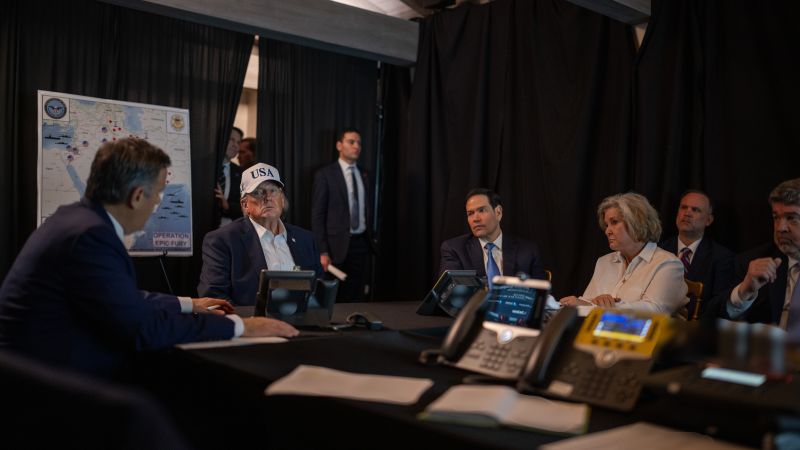
Former Trump administration officials have expressed concerns that Trump's reliance on a limited circle of advisers, rather than a comprehensive network of national security experts, has complicated military planning. This tight-knit group includes national security adviser Marco Rubio and envoy Steve Witkoff, who have been the primary sources of strategic input for the ongoing conflict with Iran, leading to challenges for military planners who were not included in early discussions.
A former official commented, "There’s no doubt there were missed opportunities with a smaller NSC" in the lead-up to Trump's decision to launch an attack on Iran on February 28. This downsizing of the NSC has significantly impacted U.S. foreign policy during critical moments in the conflicts involving Iran and Ukraine, while also aligning with Trump's impulsive management style, according to four veterans of his second term in office.
Although some former officials noted that a smaller NSC could streamline decision-making by reducing bureaucratic hurdles during crises, they also acknowledged that a larger council might have facilitated better coordination with Gulf allies regarding Iran's response to U.S. military actions. This could have led to a more thorough examination of Tehran's capacity to effectively close the Strait of Hormuz, which is vital for global oil transportation.
In March, Trump remarked that one of the most unexpected developments of the conflict was the intensity of Iran's missile strikes against Arab Gulf states. The administration reportedly underestimated Iran’s readiness to close the Strait, despite military simulations having been conducted on this scenario for years.
The NSC played a pivotal role in the 2015 agreement with Iran regarding its nuclear program, with Robert Malley, a key negotiator, also serving as a senior NSC official. Nate Swanson, who worked in the State Department focused on Iran at that time, stated that the NSC was deeply involved in shaping and executing the deal, holding numerous meetings on the subject.
In response to criticisms regarding the NSC's effectiveness, White House spokesperson Anna Kelly asserted, "The NSC is more effective and responsive to the President’s priorities than ever before." Kelly dismissed the idea that relevant entities, including the Department of War, Department of State, Department of Energy, Department of Treasury, and the CIA, were not engaged in Operation Epic Fury and subsequent actions. She emphasized that Trump frequently consults with his national security team and considers various opinions before making decisions, ultimately retaining authority as the final decision-maker.
Despite some participation from key officials in various departments during initial planning meetings prior to the attack on Iran, sources indicated that the analyses and forecasts typically integral to decision-making in past administrations were relegated to secondary importance.
Senator Ron Wyden, the leading Democrat on the finance committee, reported that Sriprakash Kothari, whom Trump nominated for the assistant Treasury secretary for economic policy, stated he was unaware of any Treasury personnel conducting analysis related to energy markets prior to the military operation against Iran. Treasury Secretary Scott Bessent informed Wyden that the department relies on numerous career economic experts for advice, though he did not clarify whether this advice pertained to the Iran conflict.
The NSC has historically played a crucial role in distilling complex information for presidential decision-making, especially in matters of national security. Approximately 20% of the world’s oil supply transits through the Strait of Hormuz, and Iran has leveraged its ability to close this strait to negotiate concessions from the U.S. during the ongoing conflict. Trump announced a framework agreement with Iran on a Sunday, ahead of a scheduled formal signing on the following Friday.
A lack of inter-agency coordination was evident when the Pentagon prioritized attacks against Iranian military targets instead of focusing on preventing Iran from closing the strait, according to two sources familiar with the planning discussions. Although significant military assets were already stationed in the Middle East prior to the U.S. attack on Iran, those assets were not equipped to deter Iran's actions regarding the strait.
A source familiar with the military’s planning noted, "After bombs started falling, there is nothing else the carrier strike groups could have provided that would have changed the calculus on closure." Kelly, the White House spokesperson, countered that the Department of War was adequately prepared for any potential action taken by the Iranian regime, labeling any claims to the contrary as laughable.
Historically, the NSC has occasionally frustrated Pentagon officials who perceive it as encroaching on their war-planning responsibilities. This perception persisted during the Biden administration, which maintained an NSC staff size exceeding 300. However, few presidents have dismantled the NSC as aggressively as Trump has. The Homeland Security Council, established post-9/11 to address domestic threats, was involved in planning for a post-Maduro Venezuela, further underscoring the NSC's operational significance.
Swanson, who served as an Iran adviser during both the Trump and Biden administrations, described the NSC in Trump's first term as having a rigorous schedule with frequent meetings focused on Iran. In contrast, he noted that in Trump's second term, the administration seems to have "abandoned the process altogether." Swanson was part of the State Department's Iran negotiating team at the start of Trump's second term until he was ousted following complaints about him being an "Obama holdover" from Loomer.
Swanson criticized the current NSC, stating, "This [NSC now] seems to be exclusively top-down decision making and fear of bringing bad news to the president."
Before President George H.W. Bush authorized military action in response to Saddam Hussein’s invasion of Kuwait in 1990, the NSC conducted extensive meetings to evaluate the implications of military intervention, with representatives from the Pentagon, intelligence agencies, and State and Treasury departments providing updates and strategies. This level of coordination exemplified the NSC's intended role, as established by Congress in 1947 following Roosevelt's management of World War II.
Historian and former Pentagon speechwriter John Gans noted that the NSC was designed to ensure that individuals from various government sectors could collaborate to generate decision-making information for the president and monitor the execution of policies. Policy experts typically take leave from their respective agencies to work at the Eisenhower Executive Office Building adjacent to the White House. Gans highlighted the NSC's founding purpose, stating, "The NSC was created because people were very scared during World War II that you had a president, who ended up dying in office, who was basically running a global war by the seat of his pants."
While there are advantages and disadvantages to a robust NSC capable of providing extensive advice, one former official remarked, "A larger NSC can handle more topics simultaneously, but there’s also the danger of a bureaucracy believing it can make decisions that rightfully belong to the president." Another former Trump official stated, "This is not a traditional administration; the president and his top officials are the ones dictating policy, so it’s a top-down approach rather than bottom-up. It certainly is way more efficient this way."
This official further contended that Trump was able to devise a plan to conclude the conflict in Gaza more effectively than he could have if he had maintained the NSC's bureaucratic structure.
However, in certain situations, bureaucratic challenges have still posed obstacles. At the beginning of Trump’s second term, nearly all NSC hiring decisions were required to go through Sergio Gor, then head of the White House personnel office, which hindered staffing in the NSC’s Middle East directorate during the Gaza conflict.
Historically, every U.S. president has experienced frustration with bureaucracy and leaks, leading them to reduce the size of their advisory circles. Even President George H.W. Bush, whom Gans regarded as the "gold standard" for NSC management during the First Gulf War, effectively ceased convening formal council meetings as the conflict progressed. One notable instance of the NSC's detachment from national security decision-making transpired last July when Defense Secretary Pete Hegseth failed to inform the White House of his decision to halt weapons shipments to Ukraine, catching senior national security officials off guard. When questioned about the authorization for the weapons shipment pause, Trump responded, "I don’t know, why don’t you tell me?"
A third former official remarked, "It’s kind of a miracle we haven’t seen more public examples like that of the NSC being blindsided by big national security decisions."
CNN’s Arpita Dasika contributed to this report.