Trump’s Agreement with Iran Poses Challenges for Netanyahu Ahead of Elections
Israeli Prime Minister Benjamin Netanyahu finds himself in a difficult position following President Trump's memorandum of understanding with Iran, complicating his political landscape ahead of October elections.
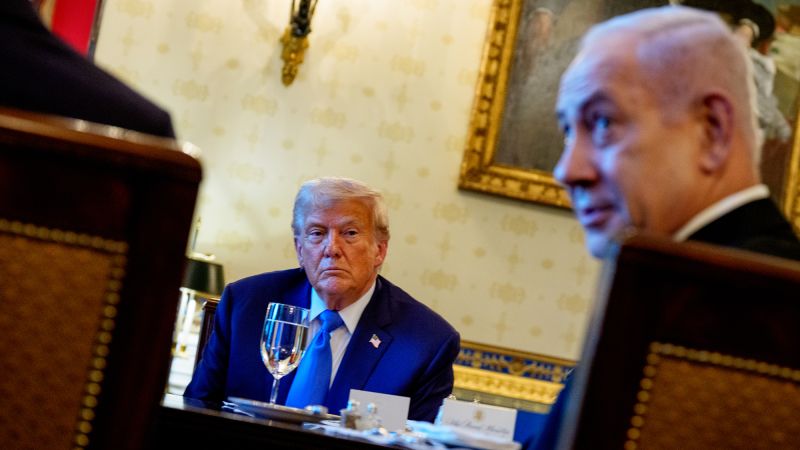
Israeli Prime Minister Benjamin Netanyahu convened with his security cabinet late Sunday night in a bunker, preparing for potential threats from Iranian ballistic missiles. During this meeting, he received a call from President Donald Trump, who informed him about a new memorandum of understanding between the United States and Iran. This marked the second conversation of the day between the two leaders; in the first, Trump expressed his frustration over Israel's recent military actions in Beirut, criticizing Netanyahu's judgment.
The memorandum of understanding has placed Netanyahu in a politically precarious situation as he approaches the October elections. Unlike his vocal opposition to President Barack Obama's nuclear deal with Iran in 2015, Netanyahu has remained largely silent regarding Trump's agreement. Previously, he had openly criticized Obama and rallied support from congressional Republicans against the deal. In contrast, his response to Trump's announcement has been muted, reflecting a strained relationship that has deviated from the triumphant narrative he envisioned with Trump’s presidency.
The newly proposed accord, which Israeli officials had anticipated with dread, could lead to the reopening of the Strait of Hormuz and the easing of economic sanctions on Iran. This outcome delays discussions on critical issues such as Iran's nuclear capabilities and its ballistic missile program, while providing economic relief to a regime that Netanyahu has long sought to undermine.
When Netanyahu finally addressed the media following the announcement, his remarks were notably brief and lacked emphasis on the deal or on Trump himself, diverging from his usual practice of highlighting their close relationship. He acknowledged that there are points of disagreement between him and Trump, stating, 'There are cases in which President Trump and I do not see eye to eye. … I am responsible for Israel’s security interests, and it needs to be done wisely.'
The agreement may also impose new limitations on Israel's military actions against Hezbollah, as Iran is reportedly demanding a complete Israeli withdrawal from southern Lebanon, a condition Israel has rejected. A senior U.S. official clarified that withdrawal was not a condition of the agreement, asserting that Israel retains the right to defend itself against Hezbollah attacks.
Despite Netanyahu's cautious public stance, reactions from various Israeli political figures have been more direct. Members of his far-right coalition, including Finance Minister Bezalel Smotrich and National Security Minister Itamar Ben Gvir, have labeled the agreement as 'dangerous,' asserting that Israel does not consider itself bound by it. Former Prime Minister Naftali Bennett described the deal as a 'dangerous turn in Israel’s security,' while former military Chief of Staff Gadi Eisenkot criticized it as a 'miserable result' stemming from a lack of strategic foresight.
Netanyahu's reluctance to confront Trump publicly underscores the delicate nature of foreign policy amidst an election campaign. Sources close to Netanyahu's political team had previously envisioned a campaign narrative built around a decisive victory over Iran, culminating in a celebratory visit to the White House and a reciprocal visit from Trump before the elections. However, the current situation has introduced significant tensions between the two leaders.
Political consultant Nadav Strauchler, who has worked with Netanyahu, characterized this moment as a 'test point' rather than a breaking point, suggesting that the relationship could still recover before the elections. He noted that Trump's historical volatility in relationships with other leaders could lead to a restoration of their rapport.
The shift in sentiment towards Trump is evident in media portrayals as well. On Channel 14, a pro-Netanyahu television network, hosts who once praised Trump are now criticizing him as a 'loser' who has weakened both Israel and the United States. A Likud source acknowledged that Trump is currently unpopular among Netanyahu's base, although they believe this could be a temporary setback.
Polls reflect this changing perception, with a recent survey by the Israel Democracy Institute showing a significant drop in Jewish Israelis who consider Israel's security a priority for Trump, decreasing from 64% in March to just 44% in the latest findings, the lowest since late 2024. Political analyst Mati Tuchfeld noted that while Trump's popularity is not crashing, it is on a downward trend, prompting Netanyahu’s campaign team to rethink their messaging strategy.
Opposition leaders are also monitoring the situation closely. If Trump were to endorse Netanyahu, his opponents plan to leverage that endorsement as evidence of Netanyahu compromising Israel's security interests. Opposition figures have reportedly been communicating with Trump's associates, urging him to refrain from endorsing Netanyahu or becoming actively involved in his campaign.
Despite the current challenges, Netanyahu's camp remains optimistic, believing the difficulties are temporary. Sources indicate that Netanyahu is quietly seeking a direct meeting with Trump to express his concerns about the emerging Iran deal, although his office has publicly denied such plans. A meeting would provide Netanyahu with the political leverage he desires, showcasing his closeness to Trump.