

Social media platforms like Threads, Instagram, and TikTok are evolving by allowing users to customize their feeds through new algorithm tools, enhancing user experience and engagement.
For many years, major social media companies dictated what content users encountered in their feeds. While individuals could follow certain accounts, react to posts, or hide unwanted content, the underlying recommendation algorithms ultimately determined what appeared in front of them.
Currently, social media platforms are shifting some of their power back to users by enabling them to personalize their algorithms with artificial intelligence.
In addition to the conventional options like 'Not Interested' buttons, platforms such as Threads, Instagram, and TikTok are implementing features that allow users to actively train their algorithms and influence the content displayed in their feeds.
This transition marks a significant change in the functionality of recommendation systems. Social media feeds are evolving from a generic broadcast model, akin to a traditional TV channel, towards a more personalized experience similar to streaming services, where users can tailor recommendations to match their individual interests and gain greater autonomy over their viewing experience.
For users, the primary benefit of these customizable algorithms is a feed that is more aligned with their interests. For the companies behind these platforms, this strategy serves to enhance user engagement by presenting content that users are more inclined to interact with.
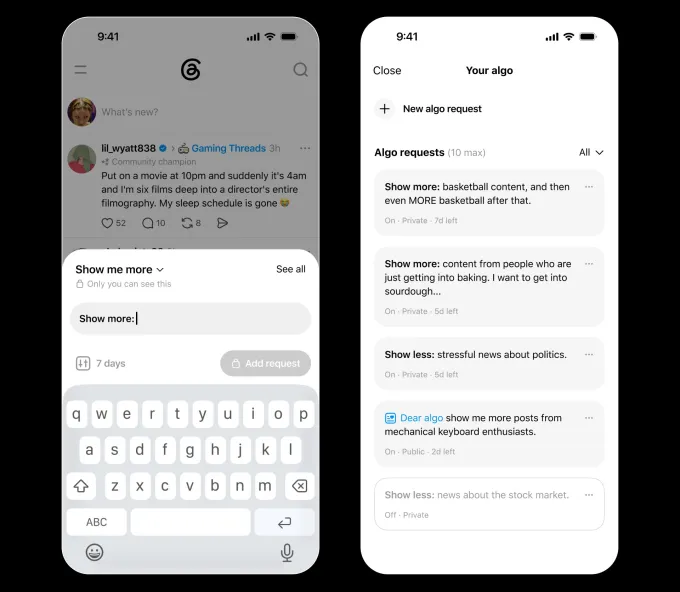
On June 16, 2026, Threads introduced the 'Your Algo' feature, an advancement of its earlier 'Dear Algo' tool launched in February. The 'Dear Algo' tool allowed users to influence their feeds by posting public requests, such as asking to see more content about podcasts. The newly launched 'Your Algo' feature enables users to express their preferences privately, without needing to share public posts.
Users can specify their desired content on Threads by indicating topics they wish to see more or less of, with the option to set the duration of these preferences to one, three, or seven days. For instance, a user could request to receive more updates about baseball while reducing exposure to distressing news.
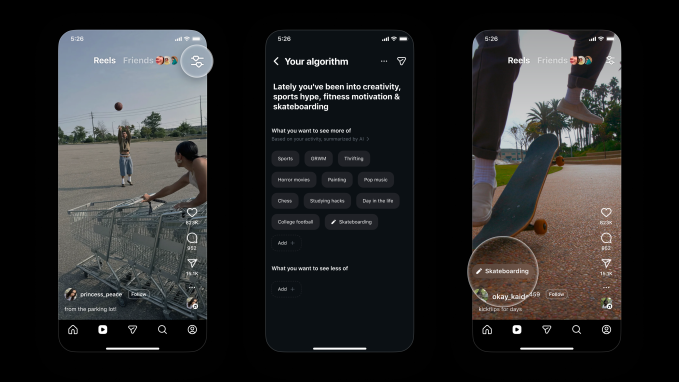
In early June, Instagram rolled out a similar tool called 'Your Algorithm,' which allows users to view and adjust the factors that shape their feed recommendations. This tool, which initially launched for the reels feed in December 2025, is now accessible across the entire feed, explore section, and reels.
Once users navigate to this feature within their settings, they can see the topics Instagram believes are most relevant to them. They can then indicate their interests, adjusting what they wish to see more or less of, leading to a more tailored recommendation experience.
Adam Mosseri, head of Instagram, noted that social media ranking systems have traditionally relied on opaque technology, but now, with the aid of large language models (LLMs), these systems can become clearer to users, allowing for explicit communication of personal preferences.
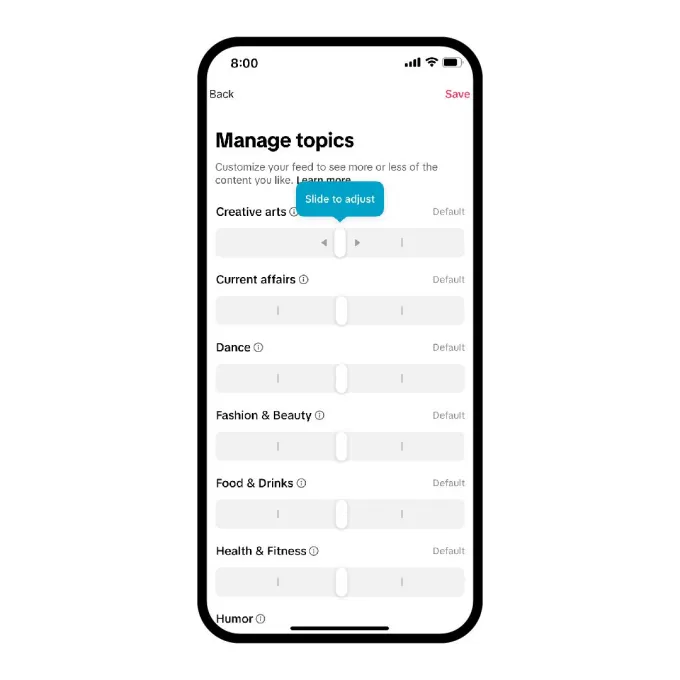
TikTok also offers a 'Manage Topics' tool that empowers users to control content visibility in their 'For You' feed. Launched in 2024, this feature allows users to customize their preferences for various topics, such as sports, travel, humor, current affairs, dance, and food, by adjusting a slider to indicate their desired exposure levels.
If users are unsure about the types of videos included in a particular category, they can click an 'information' button next to the topic. For example, TikTok categorizes 'Creative arts' as encompassing activities like painting, drawing, graphic design, and art tutorials.
In 2025, TikTok enhanced its Manage Topics tool by introducing AI-driven Smart Keyword Filters, which automatically restrict content containing associated keywords, including synonyms. For instance, if a user filters out 'remodeling,' TikTok will also exclude content labeled as 'renovation' and 'renovations.'
When users shop through links in articles, the publication may earn a small commission, although this does not influence editorial independence.
Aisha is a consumer news reporter at TechCrunch, having joined the publication in 2021 after working as a telecom reporter at MobileSyrup. She holds an honors bachelor's degree from the University of Toronto and a master's degree in journalism from Western University.
Aisha can be contacted via email at aisha@techcrunch.com or through encrypted messaging at aisha_malik.01 on Signal.
Readers are invited to gain insights from industry leaders at Mach Industries, Founders Fund, and Shinkei Systems through engaging fireside chats and networking opportunities that promise valuable takeaways and new connections.