
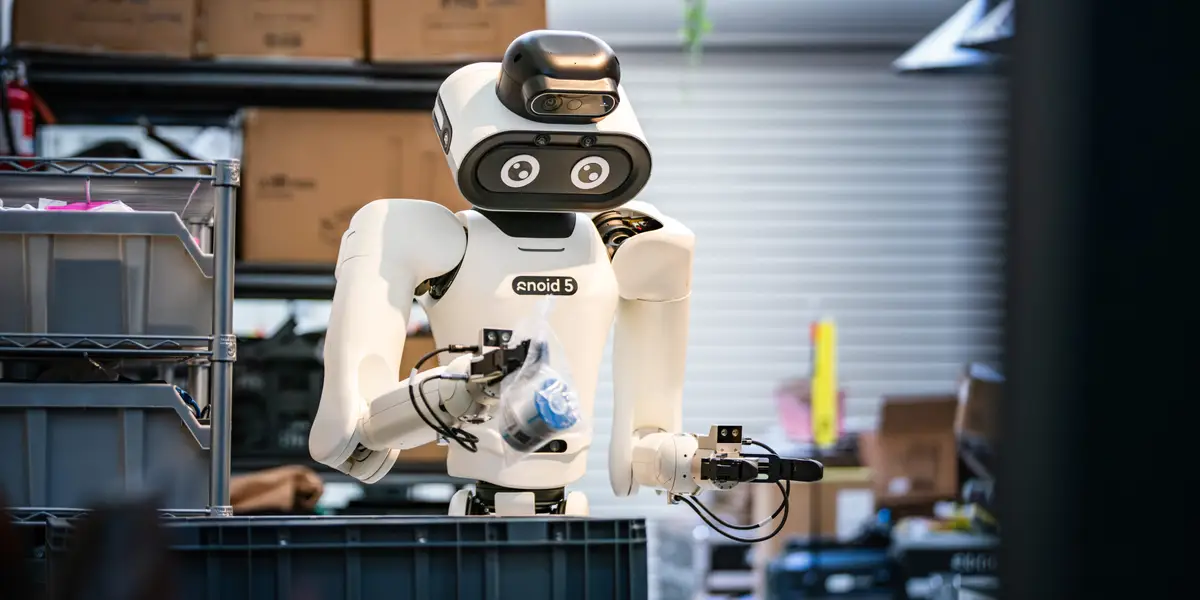
Robot.com is launching R-noid, a humanoid robot aimed at automating tasks in various industries, marking its transition from campus delivery bots to commercial applications.
Robot.com, a delivery robot startup based in San Francisco, is venturing into the realm of workplace humanoids, targeting sectors such as industrial, food services, and logistics. The company has announced the introduction of R-noid, a wheeled humanoid robot designed to perform repetitive tasks, including packaging orders, loading and unloading boxes, and preparing workstations.
Previously known as Kiwibot, Robot.com has partnered with Physical Intelligence, an AI lab, to develop custom foundation models for the R-noid. CEO Felipe Chavez explained that the robot marks a significant step in a nearly two-year effort to transition from campus delivery robots to broader commercial labor automation across various industries, including healthcare and food service. He stated, "We already have a foot in the door with our delivery robots. It made sense to also offer manipulation solutions."
Currently, Robot.com has deployed fewer than 40 R-noids across approximately a dozen customers. One notable deployment is at Harbor Links Golf Course in New York, where the R-noid assists in loading food into delivery robots and supports staff with order-packing tasks.
The company aims to position the R-noid as a practical solution for workplace automation rather than a general-purpose personal assistant suitable for homes or factories. The initial use cases for the R-noid will encompass roles such as restaurant assistant, packer, picker, folder, and host, with plans to expand the robot's capabilities over time.
Robot.com’s ecosystem includes both delivery bots and humanoids. Chavez noted that the company has amassed substantial operational experience from its delivery robot business, which boasts 500 deployed robots that have collectively completed over 2.5 million tasks. He remarked, "We have built operations, maintenance, remote operations, remote service desk, data infrastructure, and business development infrastructure. We already know what it takes to deploy robots."
A key collaboration for Robot.com is its partnership with Physical Intelligence, which focuses on developing foundational models for various types of robots. Chavez stated, "We have been working with them since last year, developing custom models for the robots that we're deploying with customers."
The startup is not the only player in the wheeled robot market; competitors such as Diligent Robotics with its Mix robot, as well as newer entrants like Sunday Robotics and Genesis AI, are also emerging with similar technologies. Robot.com indicated that its R-noid can be deployed within an eight to 12-week timeframe, a process that includes visiting customer facilities to determine which tasks can be automated and gathering extensive data to refine the robot's operational model before on-site deployment.
The amount of data required for deployment can vary significantly depending on the complexity of the tasks. For some tasks, up to 50 hours of data collection may be necessary. Additionally, teleoperations and remote support are integral to the deployment strategy, with Chavez suggesting that customers can expect around 70% autonomy during the initial deployment phase.
In the long run, Chavez anticipates that customers will see savings on labor costs as a result of implementing their robots. However, the immediate goal is to enhance worker satisfaction by integrating robotics into the workplace. "One of our motives is robots today, not someday," he concluded.