Recent explosions in Moscow have raised concerns about President Putin's grip on power and the implications for the ongoing war in Ukraine.
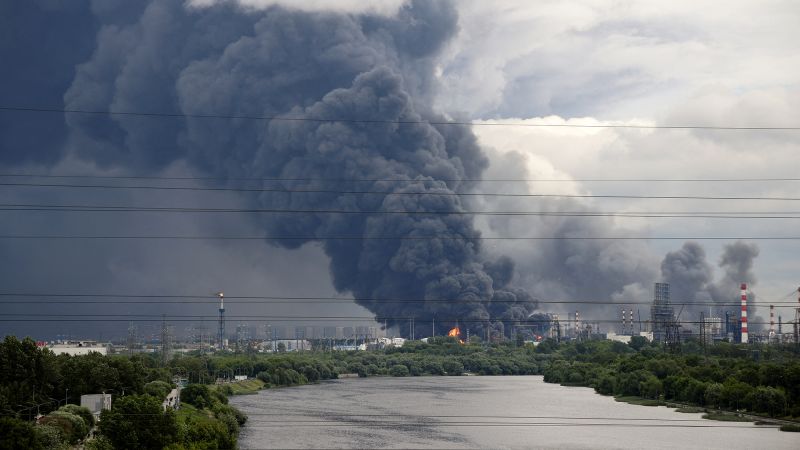
Recent explosions in Moscow have raised significant concerns about the state of President Vladimir Putin's control over the situation in Ukraine. The blasts, which occurred just 10 miles from the Kremlin, have reportedly produced thick black smoke over the capital city, marking a critical moment where even the Kremlin's fortified defenses cannot shield it from the realities of the ongoing conflict.
Videos shared on social media depict two distinct narratives. The first highlights the apparent failure of Moscow's air defense systems, which were unable to intercept drones that have now become a tool for Ukraine, once on the receiving end of such attacks. Footage shows a refinery lid blown off and multiple fires burning in close proximity to the Kremlin, leading to concerns about an environmental disaster and potential fuel shortages in a city that has been insulated from the war's consequences until now.
The second narrative emerging from these events is one of increasing dissatisfaction among the Moscow populace. Despite efforts by Russian authorities to control the dissemination of such videos, the relentless posting indicates a growing dissent that could have political repercussions. Since a small drone incident at the Kremlin in May 2023, Moscow has been increasingly vulnerable to Ukrainian strikes, which even forced a significant reduction in the scale of last month's Victory Day parade.
Ukrainian President Volodymyr Zelensky characterized these attacks as a response to Russia's continuous bombardment, which has recently targeted significant sites, including Kyiv's oldest church complex. Following discussions at the G7 summit in Evian, where former President Trump expressed a mix of indifference and support for Ukraine, Zelensky seems to have recalibrated his expectations regarding Trump's influence.
While Zelensky may have adjusted his hopes for direct assistance from Trump, he did secure an important outcome: the possibility of Ukraine mass-producing air defense systems and missiles under license from US and European manufacturers. This development suggests a transactional relationship where Ukraine is prepared to take on the responsibility of producing the necessary weaponry that NATO's supply chains are currently struggling to fulfill.
The ambiguity surrounding Trump's stance at the G7 raises questions about his willingness to pursue a peace initiative, particularly as the Kremlin has shown little interest in dialogue. European leaders, including Italy’s Prime Minister Giorgia Meloni, have expressed hopes that a mediator from a 'middle power' could reignite discussions. The UK, France, and Germany recently reiterated their position on a ceasefire, which remains a contentious point for Moscow.
Despite the ongoing conflict, there are indications that Putin might be considering a diplomatic off-ramp due to the current stalemate on the battlefield and the challenges in defending Russian airspace. He has made vague comments suggesting that a comprehensive deal and capturing the entirety of the Donbas region could coexist, hinting at a potential shift in strategy. However, his acknowledgment of the economic repercussions of Ukrainian strikes was met with calls for further retaliation.
As footage of blackened rain falls on Moscow's streets, the decision-making regarding the war rests heavily on Putin's shoulders. While there may be a temptation to seek a diplomatic resolution, the reality is that such a move could be perceived as a weakness, something Putin cannot afford. His legacy and future hinge on the outcome of this conflict, which has already claimed an estimated half a million Russian lives.
Putin's decisions throughout the war have often proven misguided, from underestimating the timeline to capture Kyiv to failing to maintain supply lines during the Russian military's collapse in late 2022. His reliance on flattery and persuasion with figures like Trump has also yielded little in terms of practical concessions from Ukraine.
Historically, Russia has undergone significant political shifts following unsuccessful military campaigns. Recent commentary from the Moscow daily Moskovsky Komsomolets highlights that 'major geopolitical losses were sometimes more useful than brilliant victories.' The outcomes of past conflicts, such as World War I and Afghanistan, have led to substantial changes in Russian governance.
For over 26 years, Putin has cultivated an image of a shrewd and calculated leader. However, the current crises challenge this narrative, as the situation outside the Kremlin walls deteriorates. It is imperative for Moscow to acknowledge its vulnerabilities while maintaining an outward appearance of strength. Achieving this delicate balance is a daunting task, and ultimately, the responsibility lies solely with Putin.