
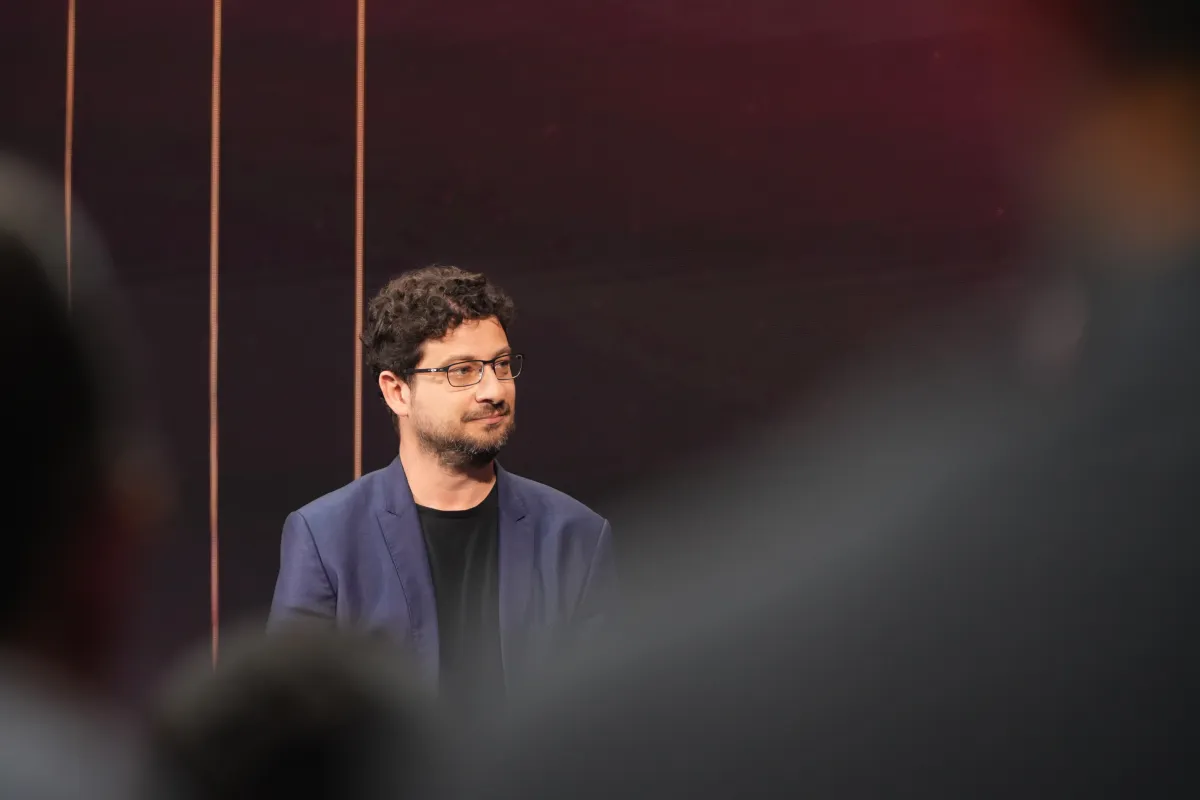
Jean-Baptiste Kempf Launches Kyber to Control Remote Devices with Minimal Lag
Jean-Baptiste Kempf, known for VLC Media Player, is developing Kyber, a platform designed to control remote devices, aiming to address the future demands of robotics and AI.
Jean-Baptiste Kempf, the lead developer of VLC Media Player, which has garnered over 6 billion downloads, is now turning his attention to the burgeoning field of robotics. He envisions a future where hundreds of millions of robots and drones will be integrated into daily life. To facilitate this, he has developed Kyber, an infrastructure layer aimed at controlling remote devices in real time.
Kyber's software consists of a software development kit (SDK) that efficiently synchronizes video, audio, sensor data, and control inputs with minimal latency. This development aligns with the growing importance of physical AI, which has attracted significant investment. Recently, Kyber secured $5 million in funding, led by Lightspeed, a venture capital firm known for its investments in companies like Anthropic and Mistral AI. Lightspeed emphasized in a LinkedIn post that the effectiveness of physical AI hinges on the quality of the systems that support it.
Kempf explained that Kyber is designed for scenarios where the operator is situated at a different location from the computing resources and the physical actions being controlled. He highlighted the significance of speed in remote operations, stating, "If you control things in the real world, every millisecond matters." This focus on rapid response times is reflected in the name Kyber, which references the lightsaber crystals from the Star Wars franchise.
Kyber's foundation in video-streaming technology is a crucial element of its functionality. The project originated as a side endeavor while Kempf was serving as the Chief Technology Officer at Shadow, a cloud gaming startup. The connection to VLC is evident due to the company's early emphasis on streaming. However, expertise in Internet of Things (IoT) optimization is equally vital, as it enhances performance based on the available computing resources across various devices.
Kempf noted that while some companies have created similar software tailored to their specific needs, such as for remote driving of vehicles, Kyber aims to scale its capabilities to manage fleets that number in the millions. He pointed out that current large fleets typically consist of only 2,000 to 3,000 vehicles, indicating a significant challenge in scaling up operations.
The expansion in scale brings heightened importance to observability, which refers to the ability to monitor and ensure that systems are functioning correctly. This is particularly critical when AI agents are tasked with managing extensive fleets and networks. Even on a smaller scale, the ability to update software without requiring physical access to each device presents substantial advantages.
Kyber's potential user base is expected to encompass a wide range of companies, although not all will necessarily become paying clients. Upholding his commitment to open-source principles, Kempf has made the core project available as open-source software, while also offering a commercial version for enterprise customers. In addition to software, Kyber provides hands-on deployment assistance through forward-deployed engineers (FDEs), a significant portion of its 25-member team.
Headquartered in Paris, with additional offices in San Francisco and Singapore, Kyber anticipates a global clientele spanning various industries. The company has already begun commercial deployments in sectors such as defense, telecommunications, robotics, and AI.
To streamline its focus, Kyber is concentrating on three primary segments: robotics, various types of drones, and remote IT access, where demand has been particularly robust. Kempf expressed ambitions for Kyber to surpass competitors like Citrix, indicating a substantial market opportunity in the remote IT access domain.
While remote IT access may not appear glamorous, Kempf is invigorated by the challenge. He noted that previous companies attempting to address this issue invested years and considerable financial resources into custom solutions, which they never shared. In contrast, Kyber aims to develop a version that can be utilized by a broader audience.