World leaders at the G7 summit are awaiting details of President Trump's agreement with Iran, which remains undisclosed and has sparked contradictory statements from both Washington and Tehran.
World leaders gathered at the G7 summit in Évian-les-Bains, France, are expressing uncertainty regarding the specifics of President Donald Trump's recent agreement with Iran. Despite the signing of the one-and-a-half page memorandum, the text has not yet been made public, leading to conflicting accounts from both the United States and Iran.
On Monday evening, as leaders enjoyed a dinner overlooking Lake Geneva, many left the event without a clearer understanding of the agreement's details. This confusion persisted despite expectations that a meeting on Tuesday with leaders from Egypt, Qatar, and the United Arab Emirates could provide further insight into the pact.
The agreement, formalized in a virtual signing on Sunday, has left even some officials within the Trump administration unclear about its terms. Reports indicate that Iranian Parliament Speaker Mohammad Bagher Ghalibaf signed the agreement for Iran, while Supreme Leader Mojtaba Khamenei was not directly involved in the signing process, as he traditionally does not sign such documents.
Vice President JD Vance is expected to attend a formal signing ceremony on Friday in Switzerland, but it remains uncertain whether the text will be released beforehand. A senior U.S. official indicated that the memorandum would likely be made public a day or two prior to the ceremony, promoting transparency. However, Trump later indicated the release could happen after Friday.
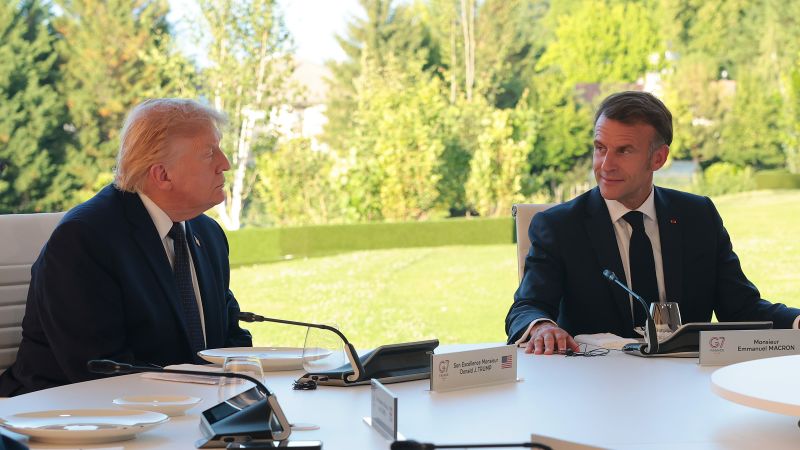
French President Emmanuel Macron and other G7 leaders are eager to review the agreement before the formal ceremony, but thus far, they have not seen the document. The lack of access to the text is raising concerns among European officials, who believe that without understanding the agreement, it will be challenging to make commitments regarding international cooperation, particularly regarding the Strait of Hormuz.
During Monday's dinner, which was themed around addressing major international challenges, Trump was seated between Macron and British Prime Minister Keir Starmer. Both leaders have criticized him in the past about his handling of the Iran situation, questioning his decision-making during the Iran war.
Trump's aides have stated that they expect European nations to assist in removing mines from the Strait of Hormuz now that active conflict has ceased. However, without clarity on the agreement's provisions regarding the strait, some European officials have expressed hesitance in making commitments.
Some of Trump's conservative allies have voiced their concerns over the lack of transparency surrounding the agreement. Conservative commentator Mark Levin publicly questioned why the memorandum was not available for public review, emphasizing the need for clarity if the agreement is beneficial for peace.
Compounding the issue of transparency, gaps in public understanding of the agreement have emerged. While Trump stated that the Strait of Hormuz would operate 'permanently toll-free,' Iranian officials claimed they would maintain control over the passage and impose fees if necessary. Vance acknowledged that while the expectation is for a toll-free strait, final decisions would be made in future negotiations.
In addition to tolls, the fate of Iran's nuclear program remains a contentious point that requires resolution. Negotiations will need to address the status of Iran's near-bomb-grade uranium and its centrifuges, as well as the scope of inspections that will be permitted.
Trump's aides reaffirm that Iran will not receive any financial relief until it meets its obligations under the agreement. However, specifics about what actions Iran must take to satisfy U.S. demands remain vague. A senior administration official noted that sanctions relief is not tied to specific actions but rather to Iran's overall behavior.
The potential for economic relief may occur relatively quickly as a confidence-building measure, with discussions of small gestures, such as sanctions relief and unfreezing Iranian assets, being considered if Iran demonstrates a willingness to meet its commitments.
The expanded summit talks on Tuesday will include representatives from Gulf nations, which the U.S. hopes will contribute to a $300 billion reconstruction fund for Iran. Officials describe this initiative as an effort to encourage investment from other countries.