President Donald Trump faces significant legal and logistical hurdles in his efforts to implement various vanity projects in Washington, D.C., as public support wanes.
President Donald Trump is encountering a series of legal and logistical challenges related to his second-term vanity projects in Washington, D.C. These initiatives are increasingly viewed as rushed and poorly planned.
Recent setbacks have notably impacted Trump's projects at the Kennedy Center and the Reflecting Pool, which have faced mounting criticism and obstacles. The administration's attempts to enhance the capital have often appeared haphazard, raising questions about their appropriateness during a time when many Americans are focused on economic concerns rather than honoring an unpopular president.
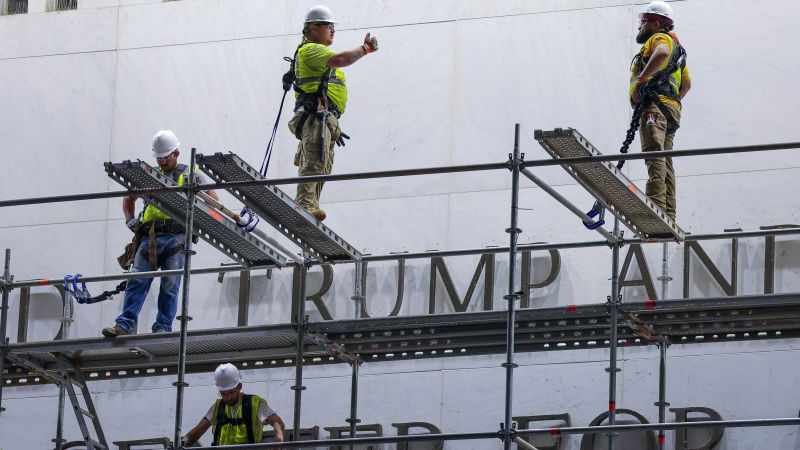
One significant issue arose at the Kennedy Center, where Trump appointed loyalists to the board. This move led to the controversial decision to place his name on the building alongside that of a deceased president, a decision that was later deemed illegal by the courts. As a result, the administration faced the difficult task of removing Trump's name, an action that was executed discreetly over the weekend. Scaffolding and tarps were used to obscure the removal from public view, and by Monday, the building's façade remained covered.
Another project, which involved painting the bottom of the Lincoln Memorial's Reflecting Pool dark blue, has also encountered difficulties. Initially estimated to cost $1.8 million, the project's expenses ballooned to over $14 million, with a contractor receiving a no-bid contract, typically reserved for special circumstances. The profit margin for this contractor was reported to be significantly higher than usual, according to an analysis by the National Park Service. Despite the project's completion being announced last week, the Reflecting Pool has since been plagued with algae growth, reverting the water to its original green color. The National Park Service is actively working to address this issue, but previous attempts to resolve it have proven challenging.
In a recent social media post, Trump shared an article from a supportive news outlet that praised his efforts to beautify the Reflecting Pool, despite the article being a week old. This highlights a disconnect between the administration's messaging and the reality of the situation.
Trump's management of the upcoming 250th anniversary of the United States is also raising concerns about its politicization. Recently, a UFC event held on the South Lawn of the White House, coinciding with Trump's 80th birthday, was marred by a fighter making an offensive remark about former First Lady Michelle Obama. While UFC CEO Dana White condemned the statement, the White House has remained silent on the matter.
Moreover, Trump suggested that the celebration of the 250th anniversary would largely serve as a celebration of himself, branding the July 4 event on the National Mall as the 'most spectacular TRUMP RALLY of them all.' This tendency to center events around himself is consistent with a broader pattern in his presidency. In light of recent cancellations by musical acts over concerns of politicization, the administration has downplayed these issues, with a spokesperson for Freedom 250 asserting that the events are 'inherently nonpolitical.'
Interior Secretary Doug Burgum previously indicated that the Freedom 250 celebration would be a nonpartisan event, but the reality appears more complex.
Trump has faced additional setbacks, including the removal of a provision from an immigration bill that would have allocated security funding for his proposed ballroom project, which he claimed would be privately funded. Furthermore, reports emerged about a potential commemorative $250 bill featuring Trump's likeness, which would violate laws prohibiting living individuals from appearing on currency. The White House eventually acknowledged that changing the law would be necessary, a prospect that seems unlikely.
Polling data reflects public sentiment regarding these vanity projects. A Washington Post-ABC News poll indicated that 68% of Americans opposed the idea of Trump’s signature appearing on currency, with only 12% in favor. Similarly, Trump's ballroom and a proposed 250-foot triumphal arch have received poor polling results. Ahead of the UFC event, a Reuters-Ipsos survey showed that only 16% of Americans found it 'appropriate' to host such an event on White House grounds, while 46% disapproved.
These developments suggest a disconnect between Trump's ambitions and the desires of the American public, who appear uninterested in monuments dedicated to a president with low approval ratings. Despite the evident challenges and lack of public support, Trump continues to pursue these initiatives.