Burt Jones Critiques Rick Jackson's Campaign Spending in Georgia Gubernatorial Runoff
In the lead-up to the Georgia gubernatorial runoff, Lt. Gov. Burt Jones targets rival Rick Jackson's record campaign expenditures, as Jackson invests over $100 million of his own wealth in the race.
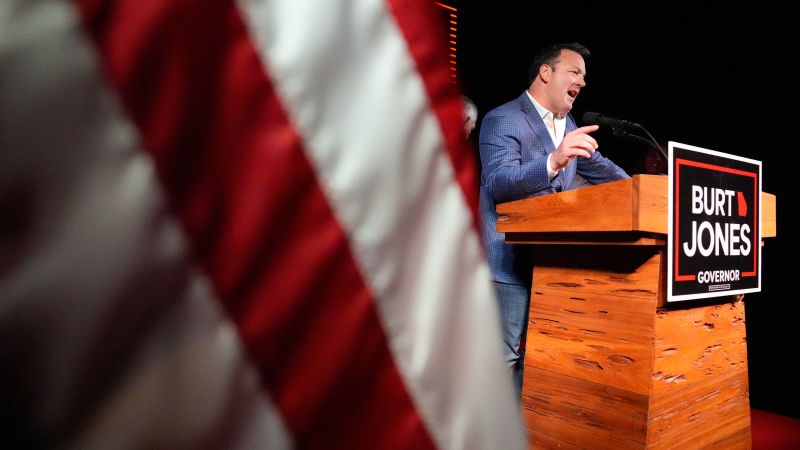
In Georgia's Republican gubernatorial runoff, Lt. Gov. Burt Jones is taking aim at his opponent, billionaire Rick Jackson, for his unprecedented campaign spending. Jackson has reportedly invested over $100 million from his personal fortune as the election approaches on Tuesday.
The victor of this runoff will advance to compete against Democrat Keisha Lance Bottoms in the general election scheduled for November. Jones's campaign has launched a new advertisement, asserting, "Rick Jackson is everywhere – spending over $100 million trying to buy our vote," accompanied by AI-generated imagery depicting voters reacting negatively to Jackson's prominent campaign presence. The ad concludes with the statement, "But Georgia is not for sale."
Jackson, a former healthcare executive, has utilized his wealth to gain visibility, spending tens of millions on advertisements and mailers to connect with voters. His financial commitment has allowed him to secure about one-third of the votes in the primary held in May, leading to the runoff against Jones.
The election presents a crucial test of whether wealthy candidates like Jackson can effectively translate their business acumen into political success, especially during a time of heightened economic concerns among voters. Jackson's campaign narrative includes a personal story of overcoming poverty, having grown up in difficult circumstances, including time spent in foster homes. Although he acknowledges the public's concerns regarding his campaign finances, he maintains that "money cannot buy this election, I’m gonna have to earn it."
In an interview with ABC affiliate WJCL, Jackson posed a rhetorical question to voters: "The question is, do you want money that’s been buying other people, through special interest groups, and donors, and so forth? Or somebody that’s spending hard-earned money in order to make a difference? Because I can’t be bought."
In the initial GOP primary, Jackson finished just six points behind Jones, outperforming notable Georgia political figures such as Secretary of State Brad Raffensperger and Attorney General Chris Carr. Political science professor Charles Bullock from the University of Georgia remarked on Jackson's rapid rise in name recognition, stating, "He’s gone from 0% name recognition to, he got a third of the vote in the primary."
As of the weekend before the runoff, Jackson's campaign had received over $100 million from his own finances, making him the second-largest spender in the 2026 election cycle. His expenditures have set records for Georgia gubernatorial campaigns, with approximately $90 million allocated to advertising that has resulted in over 380 unique ads and more than 450 million impressions, according to data from AdImpact.
Jones, who has also made substantial personal contributions to his campaign, has loaned $25 million and spent over $35 million on advertising, ranking him as the third highest individual contributor in this election cycle. He has heavily relied on the endorsement of former President Donald Trump, hosting a tele-rally where Trump emphasized the importance of voting for Jones, stating, "He’s been with me from the very beginning."
Jackson has also sought to leverage his financial resources by donating $1 million to the pro-Trump super PAC MAGA Inc. shortly before announcing his candidacy, despite Trump's prior endorsement of Jones.
Bullock cautioned that many wealthy self-funding candidates in Georgia have not fared well, referencing former Senator Kelly Loeffler's loss in the 2021 runoff and Guy Millner's unsuccessful bids for governor and U.S. Senate in the 1990s. He noted, "History has not been that you can make that transition in Georgia – maybe the explanation for Jackson is he’s willing to spend even more than they were."
In a statement to CNN, Jackson's campaign highlighted his commitment to fight for Georgians, noting, "when you grow up the way Rick did, you never forget those who are still fighting. Rick will fight for all 11 million Georgians and make Georgia the most affordable state in the nation." They also dismissed Jones's ad targeting Jackson's spending as indicative of a campaign that is losing ground.
While Jones and Jackson continue to rack up significant campaign expenditures, Keisha Lance Bottoms has already secured the Democratic nomination, winning outright in a competitive primary last month. Bottoms, a former mayor of Atlanta and Biden administration official, is now able to concentrate on her general election campaign alongside Democratic Senator Jon Ossoff, who is facing his own challenging reelection this year.
Democrats perceive the ongoing GOP runoff as a strategic advantage, suggesting that the prolonged contest will leave the eventual Republican nominee fatigued and weakened. TaNisha Cameron, Bottoms' communications director, stated, "We’re ready to face whichever out-of-touch Trump lackey emerges from the slugfest of a Republican runoff. Whether it’s Jackson or Jones, both candidates have spent the last four months beating each other up and talking about everything but the kitchen-table issues, while Keisha has relentlessly focused on lowering costs and creating opportunity for Georgians."
Jackson’s continued ability to fund his campaign remains uncertain, although he initially pledged $50 million to the election and has since increased that amount. In a recent advertisement, he declared, "I’ll spend whatever it takes to win this race."
The effectiveness of self-funded campaigns is under scrutiny, as historical examples suggest that high spending does not always translate to electoral success. Hilary Braseth, executive director of the transparency organization Open Secrets, noted, "Self-funding a campaign can buy visibility, but it doesn’t necessarily buy votes."
Recent examples illustrate this trend. In California, billionaire Tom Steyer spent over $200 million on a gubernatorial campaign that ultimately failed, despite extensive advertising efforts. Similarly, former New York Mayor Michael Bloomberg invested over $1 billion in a brief presidential campaign without securing any delegates.
Other candidates have also faced setbacks after heavily self-funding their campaigns, including progressive Saikat Chakrabarti in California and U.S. Representative Buddy Carter in Georgia, who lost his Senate bid despite significant personal investments.
As concerns about affordability dominate voter sentiment, the strategies of ultra-wealthy candidates may risk alienating the very constituents they aim to attract. Braseth pointed out that among candidates who contributed over $1 million of their own funds in 2024, only 10 out of 65 ultimately won their races.
Despite the challenges, some wealthy candidates remain optimistic. For instance, Vivek Ramaswamy, a billionaire biotech entrepreneur, is the GOP nominee for governor in Ohio after contributing $25 million to his campaign. Similarly, Illinois Democratic Governor J.B. Pritzker, who comes from a prominent family fortune, has also invested $25 million in his reelection bid. Furthermore, former Representative David Trone, founder of Total Wine & More, is set to challenge incumbent Representative April McClain Delaney in Maryland’s 6th District, with both candidates expected to spend nearly $20 million on advertising in a safe Democratic district.