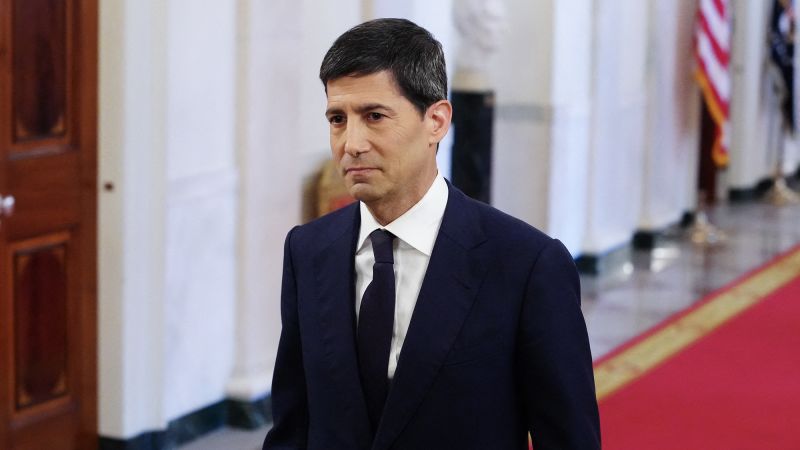
New Federal Reserve Chairman Kevin Warsh will hold his inaugural policy meeting this week, where he is expected to address interest rates and his approach to monetary policy amid rising inflation.
This week, Kevin Warsh, the new Chairman of the Federal Reserve, will preside over his first policy meeting, where market participants are keen to glean insights on interest rates. Inflation has seen an uptick recently, prompting officials to consider its implications on wages before making decisions about potential rate hikes.
The Federal Reserve is projected to maintain current interest rates during this meeting. However, the focus for investors, economists, and those anticipating lower borrowing costs is on Warsh’s future plans as the new chairman. His predecessor, Jerome Powell, was known for his transparent communication style, often addressing the media after monetary policy meetings to discuss rate decisions and field questions. This established a familiar dynamic that market observers now need to adjust to under Warsh's leadership.
Scheduled for Wednesday at 2:30 p.m. ET, Warsh's first post-meeting news conference will be an opportunity for him to present his vision for monetary policy. Wall Street is particularly interested in his outlook for interest rates, especially following a recent agreement between the US and Iran that has alleviated concerns of an inflation shock driven by oil prices amid ongoing Middle Eastern conflicts.
Warsh has indicated that he intends to implement significant changes within the central bank, which he refers to as a "regime change." This could involve reducing the frequency of press conferences and re-evaluating the Fed’s practice of issuing quarterly economic projections, which are also expected to be discussed at this meeting.
Jose Rasco, Chief Investment Officer for the Americas at HSBC Global Private Banking and Wealth, commented, "Warsh has made it pretty clear he wants to change a lot of what is going on in terms of the system and the structure at the Fed. The biggest shift would be with the projections because the market has gotten so used to them."
While inflation is indeed increasing, central bankers are cautious about immediately raising interest rates. They are assessing the underlying causes of price increases and whether these pressures are likely to continue. Historically, supply shocks are seen as temporary occurrences that do not lead to sustained inflation, which suggests the Fed could afford to "look through" these pressures, as Powell stated in March.
Richmond Fed President Tom Barkin emphasized this point at a May 21 event in Raleigh, North Carolina, stating, "Waves may rock the boat momentarily, but they rarely cause lasting damage. Raising rates to weaken demand doesn’t address the root cause behind supply shock-driven inflation. It doesn’t free up trade routes, reopen factories or melt ice."
The Fed is aware that its monetary policy actions have delayed effects and will only raise rates if there is strong evidence that high inflation will persist over the next year. Officials are particularly attentive to signs of second-round effects, where rising prices lead to increased wages and further inflation. Currently, there is little indication that such a cycle is forming, as data from the Bureau of Labor Statistics suggests that Americans are not demanding higher wages to counterbalance rising living costs.
Business surveys reveal that many companies are reluctant to raise prices despite elevated energy costs, as consumers have become more sensitive to price changes. To better understand inflation trends, Fed officials focus on core inflation measures that exclude volatile food and energy prices, which have shown relatively mild changes recently, allowing the Fed to maintain its current stance for the time being.
Furthermore, officials are monitoring inflation expectations, particularly over the next five to ten years, as these expectations can become self-fulfilling if they increase. While short-term expectations have surged, longer-term expectations have risen more gradually, according to various measures. Eugenio Alemán, Chief Economist at Raymond James, noted, "Expectations determine what will happen to prices."
Although Warsh cannot unilaterally implement the rate cuts that President Donald Trump has frequently called for—since he is just one vote among twelve on the committee—he has signaled that his tenure will not conform to past practices at the Fed. Warsh has already appointed two conservative policy veterans as temporary advisers, neither of whom has direct experience in monetary policy or banking regulation. One of these advisers is Paul Winfree, who served in the first Trump administration and was involved in developing the Fed section of Project 2025, a conservative initiative aimed at transforming the government.
The other adviser is Daniel Heil, a fellow at Stanford University’s Hoover Institution, where he previously collaborated with Warsh on economic policy and was an adviser during Jeb Bush’s 2016 presidential campaign. Warsh has suggested that there is "plenty of deadwood" at the Fed, indicating a potential overhaul of the central bank’s workforce, which consists of about 3,000 employees based in Washington, DC. Powell had initiated similar workforce reductions last year to align with broader cuts across the federal government.
Warsh has also proposed a shift in how Fed officials assess inflation, advocating for the use of alternative measures known as "trimmed-mean averages." During his confirmation hearing in April, he remarked that these measures reflect the underlying inflation rate rather than one-time price changes due to geopolitical events or fluctuations in commodity prices. With new advisers in place and discussions of a "regime change" already in progress, Wednesday’s news conference is anticipated to provide the first clear indications of how far Warsh plans to go in reshaping the US central bank.