
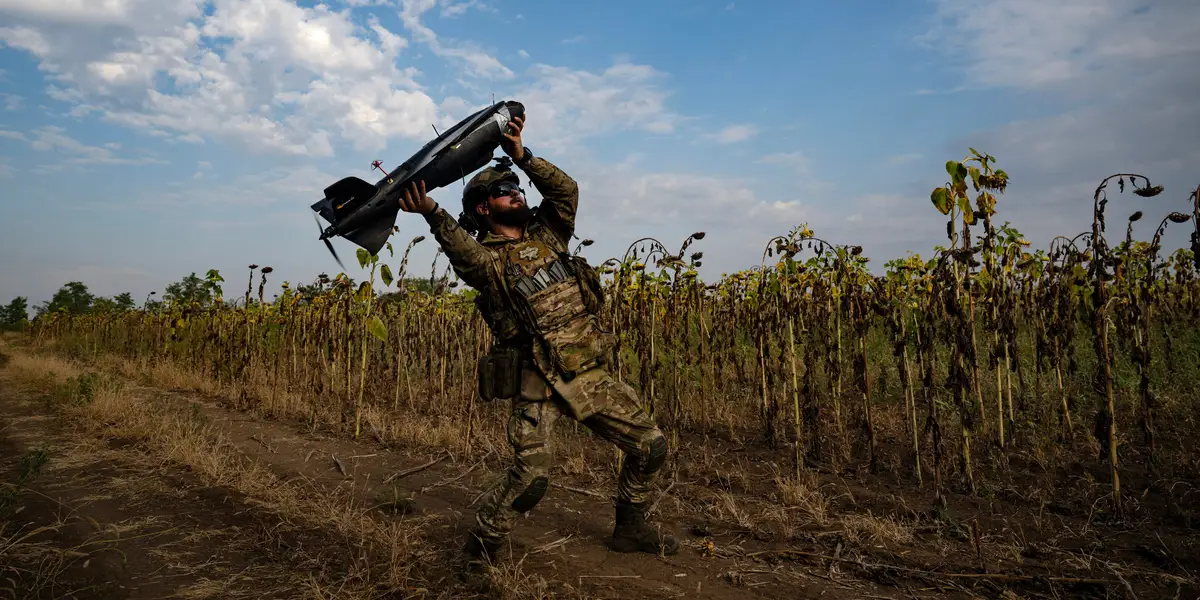
Ukraine's battlefield experience with drones has proven advantageous in NATO exercises, prompting lessons learned for Western militaries eager to adapt.
Ukraine's small drone teams have demonstrated significant advantages over NATO units during recent military exercises, highlighting their extensive battlefield experience. A Ukrainian official noted, "They always demolish the Russians on the front line," emphasizing the practical knowledge gained through combat.
NATO allies, in contrast, have not engaged in large-scale warfare for decades, which has allowed Ukraine to become one of Europe's most seasoned military forces. NATO seeks to learn from Ukraine's hard-earned expertise, particularly in drone warfare.
Tarja Jaakkola, NATO's assistant secretary general for defense industry, innovation, and armaments, remarked that Ukraine's successes in these exercises were expected, given that their troops are applying lessons learned in actual combat. She stated, "I would be surprised if it would have been vice versa," acknowledging the battlefield experience that Ukrainian forces possess.
Jaakkola made these comments during a drone summit in Latvia, attended by Business Insider, where she framed the losses experienced by NATO as valuable learning opportunities. She referenced NATO Allied Command Transformation's perspective that failures during exercises are essential for growth and development.
Adm. Pierre Vandier, head of NATO Allied Command Transformation, emphasized in March that "short of war, training is all we have to make ourselves better," calling for a more challenging and realistic training environment where forces can learn from failures before facing real combat scenarios.
Carsten Breuer, chief of defense at Germany's Federal Ministry of Defense, expressed at the summit that Ukraine's victories in exercises were not surprising and highlighted the importance of understanding NATO's shortcomings from these encounters. He noted, "I think it's clear that there's a steep learning curve for us."
Ukraine's notable victories in recent exercises included a naval drone drill off the coast of Portugal, where a Ukraine-led 'red team' triumphed over NATO's 'blue team' in all five simulated scenarios. Additionally, Ukrainian drone pilots, acting as aggressors in a NATO exercise in Sweden, overwhelmed Swedish forces, forcing a pause in training for tactical adjustments.
Sweden's chief of defense, Gen. Michael Claesson, remarked to the Associated Press post-exercise that Western forces must rapidly adapt their drone and counter-drone operations, asserting that the quickest way to achieve this is to heed the lessons from Ukrainian forces.
The exercises aim to challenge NATO forces, with some scenarios intentionally restricting the capabilities of NATO units. While a loss in an exercise does not predict outcomes in actual warfare, officials across the West acknowledge Ukraine's expertise in drone warfare and the need to learn from their experience.
Adm. Giuseppe Cavo Dragone, chair of NATO's military committee, noted in April that Ukrainian personnel frequently serve as a 'red team' in training scenarios, simulating enemy tactics to help NATO units prepare for drone attacks.
Aloian, a Ukrainian official, stated in an interview with Business Insider that Ukraine is committed to sharing its lessons learned with partner nations, emphasizing the country's readiness to contribute to collective defense efforts. He highlighted that Ukrainian soldiers possess knowledge of "new strategies" and noted their enhanced skills in implementing advanced solutions.
Olexandr Mischenko, Ukraine's deputy minister of foreign affairs, declared at the drone summit that Ukraine has emerged as a source of unique combat experiences, particularly in the use of amphibious drones, maritime unmanned platforms, electronic warfare, and the integration of advanced technologies into modern warfare. He stressed the critical importance of this experience for the security of Europe and the Euro-Atlantic community.
Western militaries are increasingly seeking Ukrainian instructors to train their forces, collaborating with the Ukrainian military for insights and working with Ukrainian industry to maximize their learning. While the West still possesses significant weaponry and expertise that Ukraine requires, the relationship has evolved, allowing Ukraine to assume a more collaborative role rather than a purely dependent one.
Units from the West that assist in training Ukrainian troops have reported gaining valuable insights during the process, using the opportunity to reassess their own training methodologies and preparations. Jaakkola concluded by expressing NATO's gratitude towards Ukraine for sharing the knowledge acquired during their challenging war.