
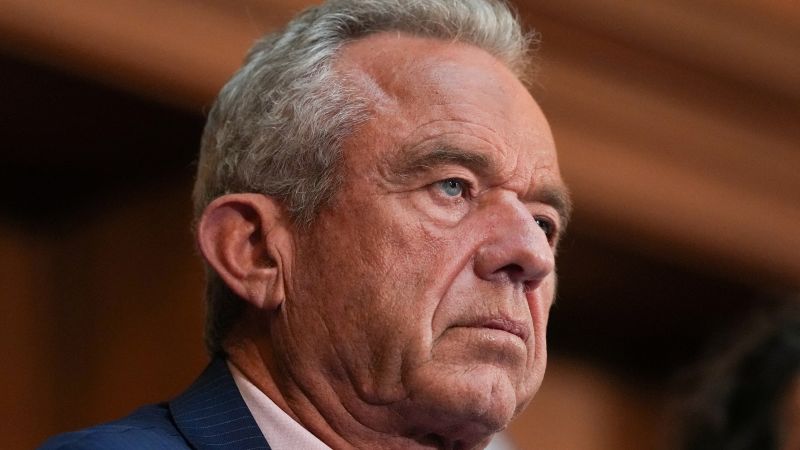
RFK Jr. Orders Quarantine for Hantavirus Exposure Despite CDC Advice
Health and Human Services Secretary Robert F. Kennedy Jr. has mandated that Angela Perryman, exposed to hantavirus on a cruise, remain in federal quarantine, contradicting a CDC expert's recommendation for her to return home.
Health and Human Services Secretary Robert F. Kennedy Jr. has ordered that Angela Perryman, a cruise passenger exposed to hantavirus on the MV Hondius, remain in federal quarantine in Nebraska, despite a recommendation from a CDC expert that she be allowed to complete her quarantine at home.
Perryman is currently one of 18 passengers who were sent to the National Quarantine Unit at Nebraska Medical Center in early May for medical monitoring after potential exposure to a rare strain of hantavirus during the cruise. While some passengers opted to stay voluntarily for the full 42-day quarantine, most have been permitted to leave the facility and continue their quarantine at home, provided their state health departments agreed to monitor them daily and ensure continuous oversight through June 21. Ten passengers have already departed under these conditions.
Perryman, who had hoped to leave by June 1, has been unable to do so, as the Florida Department of Health has not consented to the federal government's monitoring stipulations. On Monday, Kennedy signed an order affirming that her federal quarantine would remain in place.
Expressing her frustration, Perryman stated, "At this point, it’s just a state-federal spat, and I’m just a hostage." Initially, her federal quarantine period was scheduled to conclude on May 31 but was subsequently extended by the CDC until June 21.
Following the extension, Perryman requested a medical review led by Dr. Michael Bell, a quarantine medical reviewer with the CDC. The review included expert testimonies from Dr. Christopher Braden, acting director of the CDC’s National Center for Emerging and Zoonotic Infectious Disease, and Dr. David Fitter, director of the Division of Global Migration Health.
In a report issued last week, Dr. Bell recommended that the federal quarantine order for Perryman be lifted, allowing her to return home for the remainder of the quarantine, provided that Florida’s Department of Health accepted responsibility for her monitoring and had a plan for hospital care if necessary. Florida's proposal for once-daily telehealth monitoring was deemed sufficient by Bell, who argued that it met the intent of the quarantine order to prevent potential public exposure to an infectious individual.
Bell stated, "In my professional judgment, this less restrictive alternative is adequate to protect public health," emphasizing that the measures imposed by the CDC were not the least restrictive available.
However, Kennedy disagreed with Bell's conclusions, asserting in his order that the requirements for federal quarantine were still being met and that its continuation was essential for public health protection. Kennedy's order did not address the specifics outlined in Bell's detailed report.
A spokesperson for HHS, Courtney Spencer, stated that Kennedy had considered the medical recommendations before deciding to uphold the quarantine order, emphasizing the necessity of the federal measures in the absence of adequate home monitoring by state authorities.
Questions regarding the quarantine orders were directed to the CDC by Nebraska Medical, while the Florida Department of Health did not respond to requests for comment.
Perryman has expressed a loss of trust in the healthcare system, stating that she feels used as a 'prop and a political stunt.' She lamented that if there had been clearer scientific justification for the quarantine measures from the outset, she might have been more agreeable to them. "If there was a scientific reason for this, if I could see that, yes, this actually does further public health, I would have agreed," she remarked.
Perryman also recounted that Dr. Michael Wadman, the medical director of the quarantine unit at Nebraska Medical, had previously assured her that she would be able to return home after a few weeks of voluntary quarantine. She noted that she had invested $4,000 to rent a private house in Florida for the month, anticipating a peaceful environment to complete her quarantine.
In response to the situation, Nebraska Medicine stated that the information shared by the quarantine unit team was based on the knowledge available at the time of the initial quarantine order. However, it acknowledged that coordination with home states was necessary for logistics related to the quarantine.
When Dr. Wadman delivered the news of Kennedy's order to Perryman on Monday, she requested that he slip the document under her door, as she did not wish to engage in conversation. She expressed a feeling of being treated as a detainee rather than a patient, stating, "We are not patients. We are just detainees, which is a much lower level of responsibility."
At the Nebraska quarantine unit, staff members check temperatures twice daily while wearing full personal protective equipment and provide meals. Perryman receives about an hour of outside time each day, leading her to comment, "I can check my temperature in a living room just as easily as I can check my temperature in whatever you call this room. It’s like solitary confinement."