
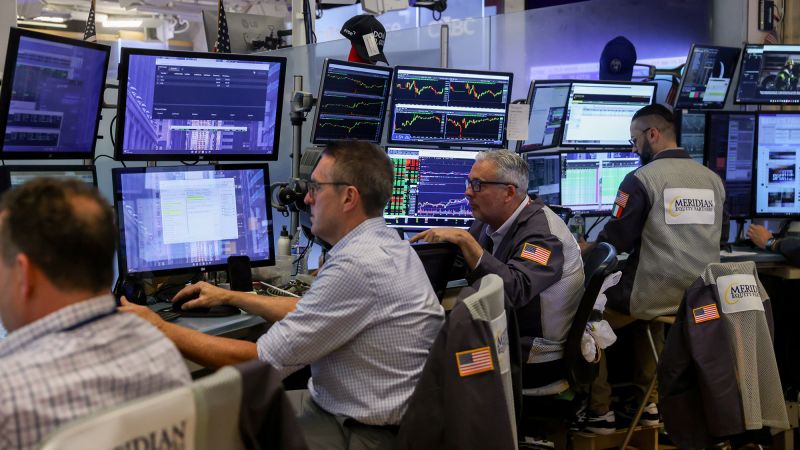
Oil Prices Decline as Stock Markets Soar, But Traders Express Concern Over Future Stability
Oil prices have decreased while stock markets reach near-record highs following the reopening of the Strait of Hormuz, yet analysts caution that optimism may be overstated.
Oil prices have seen a decline and stock markets are experiencing an uptick, following the reopening of the Strait of Hormuz. Gas prices have fallen below $4 per gallon for the first time since March, and stocks are nearing record highs. However, some analysts express concern that the current market optimism may be unwarranted given the fragile circumstances surrounding a 60-day negotiation period.
The recent agreement to reopen the Strait of Hormuz has been welcomed by markets, but there are apprehensions that the surge in stock prices and the drop in oil prices may be excessive. West Texas Intermediate (WTI), the benchmark for U.S. oil, settled at $76.60 a barrel on Thursday, marking a nearly 10% decrease for the week. Despite this, the U.S. stock market continues to rise, with the S&P 500 index up 9% since the onset of the conflict with Iran in late February.
"Traders are kind of pricing in perfection," remarked David Oxley, chief commodities and climate economist at Capital Economics. He added that while the reopening of the strait is positive news compared to the potential crisis of it being closed, the market might have overreacted. "It’s not necessarily a sign that everything is going to be completely smooth ahead," he cautioned.
The optimism surrounding oil futures and gas prices stems from expectations that oil flows through the Strait of Hormuz will increase following the U.S.-Iran agreement. However, analysts warn that the market might be overlooking significant risks and may be driven more by enthusiasm than by reality.
Current traffic through the Strait of Hormuz is significantly lower than pre-war levels, and the area was recently a conflict zone, making insurance for ships costly. Furthermore, concerns regarding mines in the strait persist. The agreement stipulates a 60-day ceasefire, after which the strait could potentially close again or face logistical issues if Iran seeks to impose traffic fees.
There are also uncertainties regarding how quickly oil producers in the Gulf region can restore production and recover from damage caused by the conflict. Adam Turnquist, chief technical strategist at LPL Financial, suggested that there are substantial risks that the situation may not unfold as positively as some market participants are anticipating.
Despite the recent rise in stock prices, the market reacted negatively on Wednesday when the Federal Reserve decided to maintain interest rates, with traders now factoring in the possibility of a rate hike as early as September. While the stock market continues to rise, buoyed by enthusiasm around artificial intelligence, the ongoing geopolitical tensions in the Middle East pose a potential risk.
"The market really likes the news that a deal was reached and then is not really thinking about the risks over the next 60 days," Turnquist noted.
As oil prices have fallen from their peaks in late April, Wall Street banks have revised their year-end forecasts downward. Analysts at Citi recently adjusted their projection for oil prices to $75 a barrel in the third quarter of this year, down from a previous estimate of $110.
Ultimately, the situation hinges on the Strait of Hormuz. Investors will need to see a significant increase in traffic through the strait in the coming weeks and months to maintain subdued oil prices. Even with this, there are logistical hurdles to restarting oil production across the Gulf region.
"We’re walking a very fine line," Turnquist concluded. "The market right now, and especially oil, is assuming a lot of things go right."