
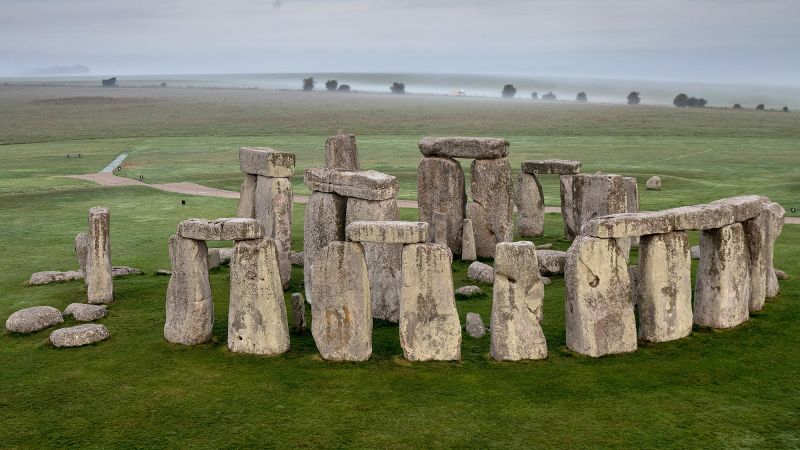
Archaeologists have uncovered a 5,000-year-old wooden structure in southwest England that could serve as a prototype for Stonehenge, aligning with significant astronomical events.
Archaeologists have made a significant discovery in southwest England, unearthing a 5,000-year-old wooden structure that may represent a prototype for the iconic Stonehenge. The structure consists of two wooden poles positioned 120 meters (394 feet) apart, aligning with the summer and winter solstices, mirroring the famous stone arrangement at Stonehenge.
This new find predates the construction of the stones at Stonehenge by 500 years, prompting a reevaluation of our understanding of ancient astronomical practices. The discovery was made by a team led by archaeologist Phil Harding, who employed radiocarbon dating techniques to determine that the wooden poles were placed into the ground approximately 5,000 years ago. This timing coincides with the period when the first earthworks at Stonehenge were established, while the stones themselves were erected later.
Phil Harding commented on the importance of the discovery, stating, "The sun was incredibly important to these prehistoric communities, and they could plot and record its midsummer rising to a high degree of accuracy." He further remarked, "This discovery is probably one of the greatest finds of my career and what makes it so important is just how early it is. Up till now, our knowledge of this ancient feat of astronomy was based on Stonehenge and other monuments of a similar period, but what we’ve discovered at Bulford is 500 years earlier than the famous stones we know so well."
The site of the discovery is located in Bulford, Wiltshire, just 5 kilometers (3.1 miles) from Stonehenge. Fabio Silva, a skyscape archaeologist involved in the project, utilized reconstructions of the ancient sky, landscape, and horizon to confirm that the poles would have aligned precisely with the solstices. Silva noted, "This discovery helps us understand Stonehenge not as a singular creation, but as part of a much longer conversation between people, the land, and the sky."
In addition to the wooden structure, archaeologists uncovered various artifacts, including pottery, animal bones, charcoal, and worked flints, indicating that people may have gathered at this site to celebrate solstices. Among the artifacts was an "extremely rare disc-shaped knife," which was placed at the site, potentially symbolizing the sun disc.
Susan Greaney, a lecturer in archaeology at the University of Exeter, who was not part of the research team, described the discovery as "intriguing," although she noted that complete details have yet to be published. Greaney stated, "The possible alignment is part of a significant middle Neolithic settlement at Bulford. It shows just how important the eastern part of the Stonehenge landscape was, with people both living and building monuments on the far side of the River Avon."