
Lululemon's Yoga Event on the Great Wall Sparks Controversy Over Japanese Drum
Lululemon faces backlash in China after a yoga event on the Great Wall featured a drum perceived to be Japanese, prompting an apology and removal of promotional content.
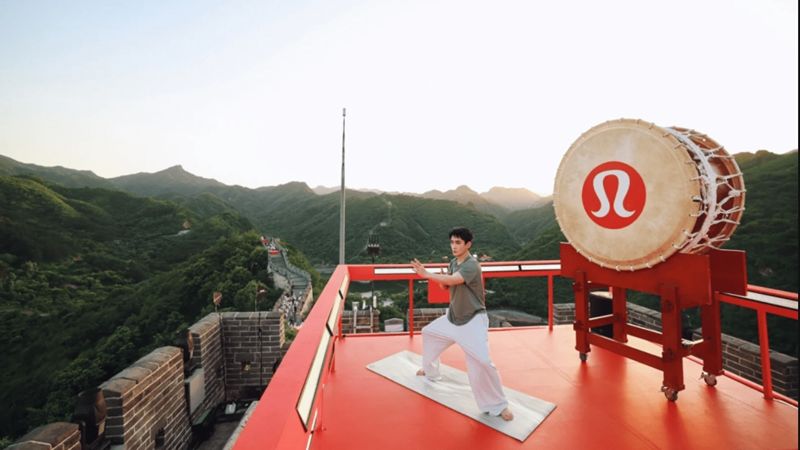
Activewear company Lululemon has encountered significant backlash in China following a promotional yoga event held on the Great Wall that mistakenly featured a drum perceived to be Japanese, igniting an online uproar.
The controversy unfolded during a yoga festival organized by Lululemon on May 30, as reported by the Chinese state-run tabloid Global Times. The event, which aimed to promote Chinese culture and wellness, attracted over 2,000 attendees who practiced yoga on the ancient stones of this iconic landmark, according to a now-deleted press release from the brand.
Among the notable participants was Chinese actor Zhu Yilong, recognized for his performances in popular films and television series such as 'Guardian,' 'The Story of Minglan,' and 'Lighting Up the Stars.' At the festival, Zhu joined a drum troupe, initially described as performing on a traditional Chinese drum, Global Times noted.
However, the origin of the drum soon came under scrutiny, with social media users and musicians asserting that it resembled a Japanese Taiko drum instead. Both drum types are traditionally large and constructed from wood and cowhide skins, but they have evolved to serve distinct cultural purposes over time, despite a shared historical background where early Japanese drums were introduced through China or Korea.
Chinese percussionist Xu Yang expressed his concerns on social media, stating that the style and form of the drums used during the event appeared more aligned with a Japanese Taiko performance. In a video posted on Weibo, he emphasized, 'They should never be confused.'
The controversy surrounding the drum gained traction rapidly, amassing over 50 million views on Weibo by Monday, as reported by Global Times. In light of the situation, Zhu’s studio released a statement on Tuesday, urging Lululemon to thoroughly investigate the event and to analyze the circumstances surrounding it. They emphasized their commitment to promoting traditional Chinese culture.
In response to the backlash, Lululemon issued a statement on Tuesday asserting that the event was intended to honor Chinese culture. They acknowledged their limitations in professional knowledge, which hindered their ability to foresee potential controversies. The company recognized the need for greater caution and thoroughness in the planning and review of drum performances and extended apologies to both Zhu and the public.
Lululemon has since removed all content related to the event from its website and social media platforms. Additionally, the HIIKO Drum Troupe that performed with Zhu issued their own apology, announcing the suspension of all external promotion and use of the contentious drums.
Despite these responses, many users on Chinese social media expressed dissatisfaction with the apologies. One Weibo post highlighted, 'On a landmark site with strong symbolic meanings like the Great Wall, every detail should withstand scrutiny.'
This incident is not an isolated case; foreign brands have faced controversies and consumer outrage in China previously. In 2021, companies like H&M and Nike encountered boycotts due to their stance against alleged forced labor in Xinjiang, while PVH, the parent company of Calvin Klein and Tommy Hilfiger, was placed on a Chinese blacklist amid a trade conflict with the US.
In 2019, luxury brands such as Coach, Givenchy, and Versace issued apologies for T-shirts that did not correctly identify Hong Kong as part of China, while implying that Taiwan is an independent nation, a significant issue for the Chinese government.
The topic of Japan is particularly sensitive given the historical animosity between the two nations. Japan’s Imperial Army invaded and occupied China during the 20th century, committing atrocities that remain a painful memory in China's narrative of the 'century of humiliation' at the hands of foreign powers.
Anti-Japanese sentiment has persisted in China, gaining momentum in recent years as nationalism has surged under President Xi Jinping, particularly on the tightly controlled Chinese internet. Calls for boycotts of Japanese products frequently arise whenever historical grievances resurface.
Earlier this year, China implemented extensive restrictions on certain Japanese goods following remarks from Japan's prime minister suggesting a military response if China attempted to take control of Taiwan by force, which is regarded as a violation of Beijing's 'red lines.'