
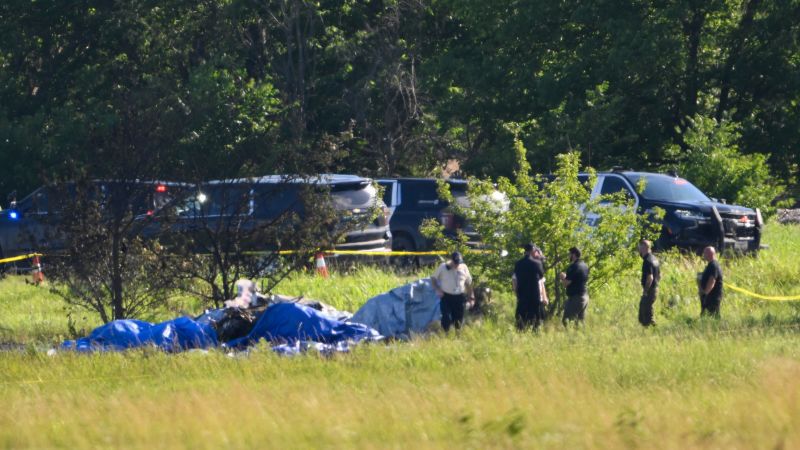
Fatal Skydiving Plane Crash in Missouri Sparks Debate on FAA Regulations
A recent skydiving plane crash in Missouri that resulted in 12 fatalities has reignited discussions about the need for stricter federal regulations governing skydiving flights and aircraft safety.
A tragic skydiving plane crash in Butler, Missouri, over the weekend has drawn renewed attention to the debate surrounding the regulation of skydiving aircraft, following the deaths of all 12 individuals on board shortly after takeoff.
Advocates for safety have criticized the Federal Aviation Administration (FAA) for neglecting to implement recommendations aimed at enhancing the safety of skydiving flights since 2008. Despite the fact that these flights carry paying customers, they are subject to less rigorous oversight compared to commercial aviation.
Jennifer Homendy, chair of the National Transportation Safety Board (NTSB), visited the wreckage of what is now the deadliest skydiving plane crash in a decade. This incident follows a similar crash in Mokuleia, Hawaii, in 2019 that claimed 11 lives. Homendy emphasized the need for changes in safety regulations.
Homendy stated, "Paying passengers should be able to count on an airworthy plane, an adequately trained pilot, a safe operator, and adequate federal oversight of those operations."
The recent accident is noted as the most catastrophic skydiving plane incident since the 2019 crash in Hawaii, according to the United States Parachute Association, which oversees the licensing and regulation of skydiving instructors while also advocating for the sport.
The NTSB is expected to release a preliminary report on the incident within 30 days, while a comprehensive final report could take up to two years to complete. In the 2019 Hawaii crash, the NTSB found that the pilot's aggressive takeoff maneuver led to an accelerated stall, resulting in the aircraft's loss of control at a dangerously low altitude.
Investigators highlighted that the pilot had only received one hour of specialized flight instruction in two days before the accident, raising questions about the adequacy of training provided by Oahu Parachute Center, the company organizing the jump.
A former pilot from the center described the training process as minimal, stating, "The company’s only direction for training was to teach new pilots how to start the engines, taxi the airplane, take off, fly the jump run, and land the airplane, after which the new pilots would be ‘good to go.’"
Attorney Gary Robb, who specializes in aviation accidents, noted the frequency of jumps, saying, "They go up, they go down. They get as many jumps as the weather and daylight permit. Sometimes it’s 12 to 15 in a day."
The NTSB's investigation also pointed out that the pilot may have felt pressured to conduct a short field takeoff to accommodate popular 'sunset flights,' potentially influencing the decision to not utilize the entire runway length.
In the wake of the Hawaii crash, the state of Hawaii determined that the Oahu Parachute Center was not properly licensed for skydiving activities and subsequently shut the business down shortly after the incident.
The NTSB urged the FAA to implement stricter measures to identify flight instructors with poor performance records, but the FAA declined these recommendations, labeling them as "unnecessary." This response was deemed "unacceptable" by the NTSB.
Skydiving operations are regulated under FAA rules known as Part 91, which primarily pertains to noncommercial flights that do not transport passengers or cargo for compensation. Skydiving flights receive an exception, but the regulations mainly focus on the handling of parachute equipment rather than the operation of the aircraft itself.
Robb criticized the oversight of skydiving operations, arguing that the lax regulations surrounding pilot training and aircraft quality have been a longstanding issue. He remarked, "Skydiving operations, in terms of the quality of the aircraft and the piloting, has been under scrutiny because they’re subject to the most lax regulations of the Federal Aviation Administration."
In 2008, the NTSB recommended that the FAA revise Part 91 regulations, stating they were inadequate for parachuting operations, particularly in ensuring pilots' proficiency in specific aircraft.
The FAA countered that accident rates for skydiving planes were lower than those for other types of private flights, a claim the United States Parachute Association has consistently defended while lobbying against stricter regulations.
During a press conference, NTSB Vice Chairman Michael Graham emphasized the need for enhanced safety measures for skydiving operations, stating, "When you jump on an airliner, you expect a certain amount of safety. Any passenger-paying operation should be afforded the same safety as that."
Graham expressed frustration over the lack of FAA action on NTSB recommendations that could enhance safety, particularly in light of recent accidents.
According to the United States Parachute Association, the number of fatalities in skydiving has gradually decreased since the 1970s, with average annual fatalities dropping from over 40 in that decade to 20.7 in the 2010s, the majority of which were due to injuries during dives.
This year marks the first time in the 21st century that double-digit fatalities have resulted from a skydiving plane crash, excluding the 2019 incident in Hawaii, according to the association.
Jeff Guzzetti, a former NTSB investigator and former FAA accident investigation division director, indicated that some NTSB recommendations for Part 91 operators might still be undergoing evaluation. He noted that the FAA often faces challenges in justifying new regulations that could jeopardize small businesses.
Guzzetti explained, "It takes a long time for the FAA to work through the bureaucracy and justify new rules that could cause businesses to go out of business."
He acknowledged that while accidents highlight issues with Part 91 operators, determining FAA oversight as a contributing factor in the Missouri crash may be necessary to prompt regulatory changes.
Robb highlighted the potential for substandard equipment and inadequate repairs due to fewer maintenance inspections required for skydiving planes compared to commercial operations.
In previous lawsuits stemming from a 2006 fatal skydiving plane crash in Sullivan, Missouri, a supplier of defective aftermarket parts ultimately agreed to pay $52.5 million to victims' families after a jury found the company liable for selling unsafe propeller blades.
Despite the inherent risks associated with parachuting, the NTSB contends that it is insufficient for operators to solely rely on liability waivers to absolve them of responsibility. The NTSB's report on the 2019 crash stated, "Even though parachutists assume a level of risk while participating in parachute jump activities, parachutists are airplane passengers during the taxi, takeoff, and climb phases of flight and should thus be assured of a reasonable level of safety, including adequate FAA surveillance of parachute jump operations."
Robb expressed hope that the recent crash in Butler might serve as a catalyst for regulatory change, stating, "That would have saved lives if we had done this two decades ago. And they still haven’t done it. My big hope is that perhaps this Butler incident will be the impetus."
This report also includes contributions from CNN's Chris Boyette.