
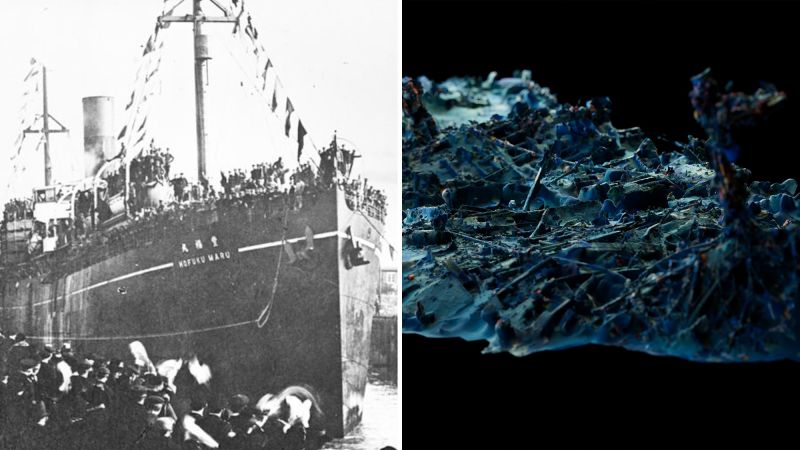
Discovery of WWII 'Hell Ship' Wreck Uncovers Tragic History of POW Transport
The wreck of the Hōfuku Maru, a Japanese ship that sank in 1944 carrying Allied POWs, has been located, revealing the harsh conditions faced by prisoners during WWII.
Researchers have successfully discovered the wreck of the Hōfuku Maru, a Japanese vessel that sank in 1944 while transporting approximately 1,200 Allied prisoners of war (POWs). This ship was one of 56 unmarked vessels used during World War II to transport POWs under brutal conditions.
A documentary from the Discovery Channel, set to air on June 24, chronicles the search that led to the identification of the final resting place for around 1,000 servicemen nearly 80 years after the ship sank.
On September 21, 1944, the Hōfuku Maru was part of a convoy navigating the South China Sea when it was attacked by US warplanes, which mistook the unmarked ship for a military cargo vessel. The planes dropped four torpedoes, one of which struck the Hōfuku Maru, causing it to split in two and sink within minutes, resulting in the deaths of most of the Allied prisoners trapped below deck. Only about 200 of the weakened and sick POWs survived the incident.
The precise location of the wreck remained unknown for decades, but recent efforts by researchers have uncovered the site. The team examined documents from Japanese and US military archives, performed sonar surveys, and conducted technical dives. These endeavors led to the discovery of the Hōfuku Maru's wreck near Zambales province, located off the western coast of Luzon, the largest island in the Philippines.
During World War II, the Japanese military operated 56 unmarked vessels known as 'hell ships,' which transported over 62,000 POWs. Of these, 19 vessels were sunk by Allied fire, with the locations of five wrecks still undiscovered.
Tim Beckensall, a World War II historian and the search director for the Hellships Memorial Foundation, described the conditions aboard these ships as dire: 'We’re talking about a dark hold that’s metal. It stinks, it’s boiling hot. There’s no sanitary conditions. They’re not being fed properly, if at all. Hardly any water.'
The discovery of the Hōfuku Maru was made possible with support from the Cultural Heritage Agency of the Netherlands and the Discovery Channel. This quest is documented in a two-part season premiere of 'Expedition Unknown' that will air on the Discovery Channel.
Explorer Josh Gates, who presents the show, remarked, 'The most surprising part of this investigation is actually the story itself — the tragic legacy of the Hellships is a chapter of World War II that many people have never heard of. But it’s vital history; the men who died aboard these ships made the ultimate sacrifice and have been waiting 80 years to be found.'
Beckensall noted that official records regarding the sinking of the Hōfuku Maru were inconsistent and incomplete. Japanese records were fragmented, and Allied strike reports provided only approximate locations. However, in June 2025, Beckensall's colleague John Duresky found a digitized document from Japanese officers aboard the lead ship in the convoy. This document included a timeline and a map indicating where the convoy was attacked, revealing that the Hōfuku Maru was the second ship in line when it was struck.
The researchers cross-referenced this document with an aircraft action report from the USS Bunker Hill, which documented the sinking of an auxiliary cargo vessel that was the second ship in the convoy. The wreck was located more than 30 miles (48 kilometers) from the previously assumed loss location. Local fishermen also reported a large wreck in the area.
Beckensall emphasized the importance of the Japanese document, calling it 'the smoking gun' that led to further discoveries. After sharing these findings with the British Embassy, a meeting was arranged with military attachés from the Netherlands and the Philippines, where Beckensall and Randy Anderson, the founder of the Hellships Memorial Foundation, presented their evidence.
The Cultural Heritage Agency of the Netherlands funded the initial sonar survey and preliminary dive mission to the site, which took place in December and January. Divers confirmed the presence of wreckage at a depth of approximately 164 feet (50 meters) in the expected location. However, volcanic ash from the 1991 eruption of Mount Pinatubo is gradually covering the wreck, complicating efforts to identify distinct features.
In early 2026, the Discovery Channel recruited maritime archaeologist Calvin Mires, who has expertise in World War II wrecks, to assist with the project. Mires and underwater imaging specialist Evan Kovacs captured hundreds of images of the wreck, which were then transformed into a 3D model using photogrammetry techniques. Mires expressed initial skepticism but acknowledged that the evidence strongly indicated the wreck belonged to the Hōfuku Maru.
The team compared the wreck's dimensions and the positioning of its masts and cargo holds against blueprints of the Hōfuku Maru, which was constructed in 1919. The wreck's condition, notably its split into two pieces, aligns with both US and Japanese accounts of its demise.
The Cultural Heritage Agency of the Netherlands has reviewed the investigation report authored by Mires, Beckensall, and their team, and has stated that the wreck is 'almost certainly' the Hōfuku Maru.
While the majority of POWs aboard the Hōfuku Maru perished, some survived the ordeal. Notable testimonies were provided by the late Capt. Nigel Evans and Capt. James Gibson during war crimes trials held in Singapore shortly after the war's conclusion. Their accounts detailed the horrific treatment endured by prisoners, leading to the sentencing of Sgt. Maj. Jotani Kitaichi of the Imperial Japanese Army to death by hanging.
Most of the Allied troops on board had begun their journey in Singapore and were being transported to Japan, where they were forced to work in factories and mines to support the war effort. Court documents reveal that the approximately 1,000 British and 250 Dutch POWs were crammed into two holds so tightly that they had to alternate lying down. Each prisoner received only three-quarters of a pint of water daily in extreme heat. Crude toilets were available on deck, but many POWs were too weak to use them and resorted to using mess tins as bedpans.
Evans recounted the worsening conditions in Manila, where nearly 100 British prisoners died while the ship was docked for over a month due to engine issues, during which time the POWs were not allowed on deck. He stated, 'Conditions on board became terrible. It was a common sight to see prisoners of war eating their meals within six feet of a corpse being prepared for burial.'
Gibson managed to escape by jumping overboard and swimming to shore, where he spent five months with Filipino guerillas. He described how his complaints regarding medical supplies, food, and conditions were met with violence from the guards.
During dives to the wreck, Mires and Gates reported encountering human remains on the decks but did not explore the holds. Gates emphasized that the ship is a grave site and confirmed that the governments of the UK, Netherlands, and United States have been informed, and they will determine the next steps.
The Cultural Heritage Agency of the Netherlands has classified the wreck as a war grave and will not permit excavation in respect for the victims and their families. No remains of American POWs are believed to be aboard the Hōfuku Maru. However, the US Defense POW/MIA Accounting Agency (DPAA) has begun efforts to account for American POWs associated with another transport ship, the Oryoku Maru, which sank in Subic Bay in December 1944, a few months after the Hōfuku Maru.
Meghan Mumford, a scientific recovery expert for the DPAA, described the recovery efforts as among the largest and most complex missions undertaken. Earlier this year, a team of specialist divers began removing sediment from one of the cargo holds believed to have housed POWs, and efforts to identify human remains are currently underway.
The exact coordinates of the Hōfuku Maru wreck, located off the coast of San Narciso, are being withheld to protect the site. The Hellships Memorial in Subic Bay honors the memory of those who died aboard the Hōfuku Maru, and the Netherlands has committed to collaborating with other nations to find an appropriate way to commemorate the victims.
Mires reflected on the emotional impact of his work, stating, 'The POW ships are really a forgotten part of the battles and the war, and they’re dramatic and horrific and monumental on all levels.'